Friday, February 5, 2021

Building a set out of envy? That's Crazy : a look at 1985 and the 1979 TCMA Pro Japanese Baseball Set.


What are the statistics for someone building a baseball card set out of jealousy?

Or out of sheer envy?

Anyone ever built a set based on long-standing resentment?

            Why would anyone even build a set for such reasons? Collecting is supposed to be fun, right? I’m having fun for the most part, being back in the hobby; although small holes of discontentment creep in from time to time. Such is the life of a long-suffering Pirates fan. I enjoy building sets, both old and new, in ways that I never had as a young collector. I enjoy printing up the checklists, cracking some wax, and collating the cards. Purchasing a card online and marking one more slot off on the checklist. Building sets helps with my anxiety. Sometimes it feels like I’m pulling together history.

So why build a set out of jealousy and envy? To explain I have to go back to 1985, a year I’ll be revisiting more than a few times in this blog. 1985 was probably the first time I’d ever seen one of those baseball card variety packs. Think distant cousin to the current Fairfield ones that you buy in a Walgreen’s, when in a card fix, with no internet or LCS in sight. As I remember it, those variety packs came in cubes with a card featured on each side, or in tightly wrapped cellophane in sparsely decorated boxes. We got them at toy stores. Any Rust Belters or former Rust Belters out there remember Children’s Palace?


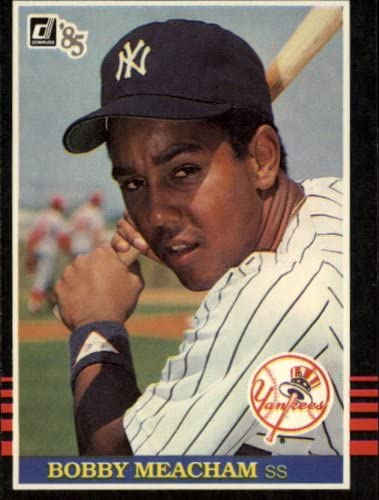
As with the current Fairfield product, the pickings in these 1980s style variety packs were mostly unremarkable. I say mostly because, yes, I have watched a guy online pull a Bryce Harper rookie card out of one of those variety packs. I myself pulled three 1985 Donruss Bobby Meacham cards.

On the particular day in 1985 that I’m writing about here, my brother and I were strolling around the Children’s Palace with our friend, Phineas. It was shortly after Phineas’ birthday and he had some birthday cash burning a hole in his pocket, as it did with most kids lucky enough to receive a few dollars celebrating the year of their birth. Phineas’ mom watched my brother and I from time to time, although I was already reaching latchkey age, so we were a captive audience for his splurge. While we were mostly there for toys, we came across these baseball card variety packs sitting in one of those random, enticing toy store bins. In lieu of buying anything Star Wars related, Phineas bought the variety pack of cards instead.

            The group of boys I knew in 1985, well, to say that we were deep into baseball cards would not be an accurate description of the ocean we consistently swam in and whose bounty we drank from. Cards were all we wanted. Phineas was building a 1985 Topps set. I was buying packs and packs of random brands, doing my usual business of discarding the commons to one shoe box, and keeping stars and Pirates team sets in another, better shoe box. Cards beat playing with action figures, a rabid past-time whose grip on my attention was lessening and lessening each day on the march toward puberty. I felt that while I could watch He-Man I could not justify picking up an action figure and playing with one.


I even got into petty thievery that year, though fall of 1984 was when I made my first big “score”. I’ll admit to nothing but stealing a few packs of Fleer from Revco. Maybe I desecrated a Topps rack pack or two then justified the purloinment by saying to myself that such a rack pack wouldn’t be missed. A kid with not a lot of money did what he had to do back in Reagan’s America. It wasn’t morning in America in my Velcro, Pirates wallet. I took the Robin Hood ethos to heart. I never claimed to be a true capitalist.

            The cards in Phineas’ variety pack were unremarkable…for the time. A random assortment of Topps, Fleer, Donruss, and some odds and ends we’d never seen. That being 1985, hell, now I’d love to open a variety pack full of random cards from 1980-1984. One man’s junk is another man’s vintage. But, again, as I remember it there was nothing much to write about in that variety pack. Ah… except for one card. A card none of us had ever seen before in our lives. A strange looking player, on a strange team, from strange city, in a country none of us had ever been to. He had a strange name too: Shigeru Takada.


    Who in the hell was Shigeru Takada? Who in the hell were the Toyko Giants and why in the hell did his helmet look like that? These were the questions that I had burning through me, as Phineas continued to go through his variety pack. When he was done and had moved on to other cards, I stuck with the Shigeru Takada card. Pulled it out of the pile. Examined it. Held it like a rare jewel. It was. I’d never seen a baseball card of a Japanese player before. I wondered how this card made it into that variety pack, and then made it’s why to a Children’s Palace toy store in the suburbs of Pittsburgh. In short, I craved that Shigeru Takada card and wished it were mine.

A trade perhaps? Phineas was a notorious wheeler and dealer when trading, and was known to not want to part with his cards. Like, any of his cards. But, aside from the initial fascination, he didn’t think much of the Shigeru Takada card, right? I mean he’d left it to sit there in that pile of commons. Good ol’ Phineas didn’t seem to care at all about the Shigeru Takada card…that is, until I expressed an interest in it.

Then the card instantly became one of the crown jewels of Phineas’ whole collection. Not as important as Pirate cards or certain star cards, or the rookies he wanted. But more a point of pride. The Shigeru Takada card became something to lord over a hapless beggar such as I. A card to entice me into trades, but never, ever to be relinquished from his stronghold. He still has and talks about that Takada card to this very day. Cursed Phineas!

I was determined to get Takada card another way. But how? Children’s Palace, of course. But how many parents did you know who regularly wanted to drive their kid to a toy store. I know mine sure as hell didn’t. Besides, my poor mom was already carting us out to one baseball card shop in the mall on the regular. In the rare times that I got to go to Children’s Palace, I bought every variety pack that I could afford. But I never came across a Shigeru Takada in the wild again. Never came across another Japanese Card. The variety packs vanished from the bins. Still, I resolved to one day make the Takada card mine.

            Flash forward thirty-five years and one pandemic later. I was in the doldrums. Feeling trapped at home. Feeling fearful of everyone and everywhere else. Ambulances roared down our street carrying the sick and dying. I began thinking of trips my wife and I had taken in 2019, and would we ever get to travel together again. I’ve perfected the art of drama mixed with a healthy dose of paranoia and anxiety.

We were fortunate enough to go to Japan. That beautiful land of the rising son. I’ve been around the block and have been fortunate enough to have visited quite a few European cities, but nothing prepared me for the majesty of Japan. 

The crowds


The neon. 

The shrines. 


The food. 

This beautiful place

The efficient trains and subways that melted this New Yorker’s heart. The kindness of the people. 

And, sadly, being confronted with a little bit of America’s own dark history.


I wanted to see a baseball game so badly. I hadn’t been to a live game in America since 2014. But there were no live games to be had. In each city we went to, the home baseball team was playing somewhere else. The folly was laughable. The closest I got to Japanese baseball on that trip was visiting the Tokyo Dome and pulling into Hiroshima just as a Carps game was starting, and tons and tons of fans of all genders and ages were heading toward the stadium in Carp red. 

I settled for watching the Soft Bank Hawks at night on our hotel tv, and catching a Giants game in an Irish pub. It is my determination that one could find an Irish pub on Antarctica.

In the midst of my memories, hungering for a bowl of good, spicy ramen, I did a search on ComC for Japanese baseball cards. That search lead me to the TCMA 1979 Japanese Pro Baseball set. Something about the cards looked familiar. The plain, white border. The colored crescent in the center of the bottom of the card, listing the players name and team. The simple white and red backs that listed some biographical information on the player and their 1978 stats.


More memories flooded me. A friend’s bedroom lit by the afternoon summer sun. The smell of wax, cardboard and gum. A certain variety pack. It was like I was back in 1985, and seething in the pit of want, envy and jealously. Until I shook them off and let the purchasing power of an adult be my guide. It only took me a matter of time before I found him on ComC. Shigeru Takada.

I immediately added him to my cart. Mine for good this time. My precious.


The Shigeru Takada card actually comes from a set produced in 1979, known officially as the 1979 TCMA Pro Japanese Set. It turns out the set isn’t very Japanese at all. Yes, the 90-card set features players who played in Japan. But TCMA was actually a card company from upstate New York, in the 1970s and 80s, known mostly for its minor league sets and its 1975 challenge to the Topps monopoly by creating a 600-card set of major league baseball players known as SSPC; a pretty sharp set if you ask me. The Pro Japanese Baseball Card set was never even marketed it or sold it in Japan. No wonder cards from it ended up in a run of the mill baseball card variety pack.

            As for Shigeru Takada himself, he was an outfielder/third baseman who played thirteen seasons for the Yomiuri Giants. Takada played in 1512 games in Japan with 1384 hits, 139 home runs, 499 RBI, and a career batting average of .273. After his playing days, Takada managed for the Hokkaido Nippon-Ham Fighters and the Tokyo Yakult Swallow. He was also the general manager for the Yokohama DeNA BayStars, and is still alive and well at the age of 75. I’m not a big autograph guy, but, man, it would be cool to get his card signed.

            Anyway…I didn’t really buy the card out of envy. I bought it because it’s cool, and the Takada card reminds me of my youth. I’m glad Phineas still has it and enjoys it to this day. I know I’m enjoying mine. That said, purchasing the Takada card has sort of resolved me to collect the entire 90-card set. I have about a handful of them now, and kind of want to build it slowly, enjoy the process. 


You can get the cards on both SportLots and ComC at pretty good prices. Only one of the cards is really going to cost you. And that’s the card of the big fish. The all-time, global home run champ. The legendary Sadaharu Oh.


Lastly, I decided with this post to take a walk down memory lane and actually buy myself a Fairfield variety box to open and see what I could find inside...but Brooklyn retail stores had other ideas. My neighborhood is usually a desert for retail sports card product (I think I’ve found maybe one or two hanger boxes at my Walgreen’s), but they often have Fairfield stuff. Not this time. I should’ve known my luck. Another time, perhaps.

 Anyway…Thanks for reading. Happy collecting.


 If you want to learn more about Shigeru Takada you can do so HERE.

If you want to learn more about Sadaharu Oh you can do so HERE and HERE

Next Friday: Topps 2021 Flagship Series 1 releases on Wednesday, February 10th, so I think next week I’m going to post about opening the very first wax box that I ever purchased with my own money, and take a small, slightly critical (and that can mean good or bad) look at what Topps has done with their 2021 Flagship brand.

Here's a Sneak Peak: 


Friday, January 29, 2021

how does one become a collector : or why I loved Bobby Bonilla and Bo Jackson rookie cards


How does one become a fan of a particular player?

            A collector?

            Thinking back on when I was a little kid, interested in sports yes, but not yet able to understand the nuances of a game, or even sit through one until I reached a certain age, and obviously unaware of those statistics that rendered a player a star or a so-called common player; how did I determine which players I loved or didn’t. Which cardboard hero struck me while opening packs? What did I have to spark my fandom before I was a true fan? Was it legend? Reputation? Word of mouth from people older than me? Case in point, I offer this: as a kid growing up in Pittsburgh I loved, LOVED, Terry Bradshaw and Willie Stargell. Still do.

            I mean…check this out:


Bradshaw and Stargell were/are legends in Pittsburgh. Bradshaw was a four-time Super Bowl champ, a three-time all-pro, an MVP and a Hall of Famer. He was part of a Steeler’s dynasty in the 1970s whose legend, in my opinion, the team still coasts on from time to time. He even recorded country albums and got into a bar fight with Burt Reynolds…on the movie screen anyway. Terry Bradshaw’s very name made me excited. I wanted to be Terry outside throwing touchdowns. I wanted his cards. I was excited to get his cards in packs (primarily 1982-1984). I still want his cards. I haven’t really gotten back into football collecting since my return to The Hobby in 2019. But if I do, I’m buying me some Terry Bradshaw cards.

The same goes for me and Willie Stargell. Or, Pops, as we call him in the ‘Burgh. Stargell was an MVP, a seven-time all-star, he made it to the World Series (and won) twice, garnering himself a World Series MVP award in the process. He finished his career with 475 home runs. I mimicked his batting stance, before I knew about any of that. There’s a statue dedicated in Willie’s honor, that I visit every single time I’m home and catch a game, outside of PNC Park. One of the first players that I started PCing when I returned to The Hobby was Willie Stargell, because I knew any collection of mine would be incomplete without him. My current, most cherished card is a beat-up, off-center 1964 Willie Stargell Topps card.

With all of those stats/awards I mentioned, it’s talent that obviously makes one a fan, right? Makes one a collector of a player’s cards?

Willie Stargell and Terry Bradshaw made Pittsburgh the City of Champions by the end of the 1970s. But, if I must be truly honest, when I really started paying attention to sports, say age 8 or 9, Willie Stargell was an aging, slightly overweight 40-year-old ballplayer, who was being used more as a pinch hitter than a first baseman. He was hitting the last of those 475 home runs. My lasting images of Pops are of him hobbling around the bases on those bad knees when he hit a home run, or having someone pinch run for him when he hit a single. Regardless, Willie Stargell’s 1983 Fleer and Donruss cards were the ones I wanted when that year’s sets came out. And he was officially retired by then.


With Terry Bradshaw it was the very same situation. When I started watching the Steelers, they were a few years removed from Super Bowls, and at the beginning of a spell that would see them struggle to win nine games a season. By 1983, Terry Bradshaw was a 34-year-old quarterback with constant elbow issues, who missed almost the entire football season, only coming back for two quarters of one game against the Jets (in Shea Stadium), before he felt his elbow pop, was removed from the game, and was done for good. Yet My favorite card in the classic 1984 Topps Football set is Terry Bradshaw’s card. Not Eric Dickerson’s rookie card or John Elway’s. Not even Dan Marino, the local Pittsburgh boy (and fellow high school alumni), who the Steelers could’ve drafted as their heir apparent had they been aware of how bad Bradshaw’s elbow injury had really been.

That’s the Willie Stargell and Terry Bradshaw that I remember. The fallen heroes. The aging champs. The old men trying to win one more game.

            How does one become a fan? A collector? For those guys does it rest on legend alone?

I think back on a cold early spring afternoon, in 1987, hanging out in Dimitri Danielopoulos’ bedroom. D, as I’ve stated in earlier posts, was always the first one in our neighborhood to get that season’s new baseball cards. And that afternoon he had 1987 Topps. Like the hungry animal for wax and gum stained cardboard that I was, I went through his stack ravenously, looking for the big rookies I knew awaited us that year, always looking for the Pirates cards as I went along.

That particular afternoon I came across this:


I knew little about Bobby Bonilla in early 1987. At most, I knew that Bonilla had once been a prospect in the Pirates system but had been traded away. Bobby had come back to the Pirates organization in a late 1986 trade, so late that the card manufacturers still had him in his White Sox uniform when their traded, update and rookie sets were released. In 1986, Bobby Bonilla was a new face in a sea of new faces as the Pirates tried to get out of their rut. We had a new manager. New players. We had a new buddying legend in Barry Bonds. Bobby Bo was lost in the shuffle to me…until that moment in D’s room.

Looking at that card in D’s bedroom that cold, spring afternoon something struck me. It was like I could just tell Bobby Bonilla was going to be big time in Pittsburgh. A player with some tools. A stud ballplayer. Head cocked sideways and his cap tilted with his bat resting on his shoulder. A forearm of veins and muscle; Bobby Bonilla looked like a superstar in the making. The kind of player I wanted to get behind and root for in every game. A legend if he played his cards right. Like Stargell. Bobby Bonilla’s card looked cool. I decided right then and there to become a fan and collect every piece of cardboard with him on it that I could pull out of a pack or find. I’d worry about the stats as I went along.

            Bobby Bonilla didn’t disappoint us in Pittsburgh….at least not on the field. In his six years in Pittsburgh, Bobby Bo was an all-star four times and he won the Silver Slugger award three times. in 1990, along with a lot of other bright, young stars, Bobby Bonilla helped lead the Pirates to their first NL East Championship since 1979. He would do it again in 1991, before leaving Pittsburgh and the Pirates to sign with the New York Mets, and forcing me to endure this card:  

One of the few 1993 Topps cards that I actually owned since I was basically done collecting by then. But I had to have Bobby’s card that year because my gamble had paid off. I’d picked a star and got to watch his legend grow. Bobby Bonilla was going to be a career long star and a hall of famer for sure…sigh. And yes I do celebrate Bobby Bonilla Day.

Bobby Bonilla, despite how his career finished (not Hall of Fame worthy but pretty respectable), reflected an era that I was in where I could watch the players play, understand the game as an avid fan, read box scores, and generally have an emotional attachment to the team/sport of my choice (don’t get me started on Game 7 of the 1992 NLCS). In a way, I could invite the players into my home on a regular basis. My card collecting wasn’t predicated on legend by the mid-80’s, or on wishing I’d seen a player like Terry Bradshaw, Willie Stargell, or the recently departed Henry Aaron (another player whom I loved for years without having seen him play a single inning of baseball) play the game, but more on statistics and the professional performance of the athlete. By the mid to late 1980s my card collecting fluctuated like the Stock Market.

And it wasn’t just Bobby Bonilla’s 1987 Topps card that drew me to him as a collector that year. As I’ve stated here before, there is something about the 1987 brands, in general, that really grabs me. They’re in my wheelhouse, to use a lesser term. I don’t know if it had something to do with me being thirteen and having my own cash to spend of 1987 cards, like I’d had in no other year. In short, I had the kid version of purchasing power and could buy more cards. Plus, I also had greater access to 1987 Fleer and Donruss cards, as we progressed further into the so-called Junk Wax Era, and more stores began to stock cards. Or the cards were just damned good looking that season.

            The 1987 Topps Bonilla is my favorite, but that doesn’t mean I don’t absolutely love his Fleer and Donruss cards as well.


I’d say his 1987 Fleer is my second favorite base rookie card. While I like the design of Donruss, and consider that brand my second favorite set of that year, there’s something about Bonilla’s Fleer rookie that beats it out. The blue border, obviously; I think what really wins Bonilla’s Fleer rookie is that it’s the only one of the three that has him in an action shot, or waiting for the pitch, a semi-action shot. Here’s Bobby Bonilla at the plate ready to knock one out of the ballpark. 1987 was also the last year I got to see Pirates cards with players still wearing that yellow/gold batting helmet. A dividing line between the past and present, the old glories and dark years, and all of the light that was to come (1990-1992). On a more base note, the Fleer Bonilla just plain beats the close-up shot that Donruss chose to go with that year.

Anyone else love this card?


As a seventh-grader in the spring of 1987, life began to throw a lot of distractions my way, as I’m sure it did to a lot of you out there. There were girls, although I liked them way more than they liked me. There were sports. Music purchasing began to creep into my modest paperboy salary. But a good many of us still traded cards at school; actually, by 1987, I’d say more of us than ever were trading cards at school. We did so on lunch and recess, and at our own peril in class. Future millionaires who had no need for English class. No matter what, in that year of 1987, I never traded a Bo Jackson card to anyone. I kept them separate from the other cards. I carried his Topps rookie in a top loader, like a talisman in my pocket.

            Not only is Bo’s Topps rookie my favorite of his, it might actually be one of my favorite cards ever made. I won’t bore you with, yet again, praising the 1987 Topps design. Let’s focus on Bo himself. Young Bo. Hungry Bo. Bo focused on a pop fly coming his way. The way the royal blue of his hat and jersey stands out in the sun. Bo before Bo knew anything. Future Star like a rainbow blast below the image. Damned near a prophesy of truth had it all not come crashing down on an L.A. football field in 1991. Everything in Bo Jackson’s 1987 Topps rookie jumps out for me. It speaks to me as everything I’d want in a sports image, and it’s so perfectly cast in a baseball card. I’m always excited to get one in a pack, or find one at a show. That card still thrills me.

            But then there’s this card:


    If I’m in love with Bo Jackson’s 1987 Topps base rookie card, then I flirt beyond my own sense of shame with his Donruss rookie. I can’t tell if Bo is working out in the image, or if he’s tossing a ball and we just can’t see his glove. But this card is where Donruss really shines in 1987. It’s the card where the black of the border and the blue of Bo’s uniform crash into this perfect symbiosis of color. The stadium behind him is just darkened enough. The grass on the field the right kind of green. Bo Jackson’s 1987 Donruss is the kind of card that I’d show someone if they told me that sports cards weren’t works of art, to prove their narrow-minded ass wrong. This sucker should be hanging in the MoMA. I think I’m going to sneak one on the walls the next time I visit.


     I should say a little bit about the Fleer Bo Jackson rookie card. And a little I will say. I like the card. But I think I like it because it’s a Bo Jackson card, as opposed to it lending me any aesthetic value. The Bo Jackson rookie card is one of those few times where I think 1987 Fleer fails to capture a future star player in all of his glory. The player photo is dull and there’s too much blue. Bo looks like he stopped briefly to flash a smile before heading off to shag baseballs again. I wish Fleer had done something exciting with his rookie card. You put Bo in a white uniform and give him a Bonilla-like action shot and you’d have a winner. But, it’s still a Bo card. His 1987 Fleer just doesn’t capture the majesty of his Topps or Donruss to me. But you know what they say about opinions, right?

            This brings me to a final thought, or personal query. What is fandom and collecting to me now? I’m talking current players here. As evidenced with Terry Bradshaw, Willie Stargell and Henry Aaron, while there is an aesthetic value to the cards, I cherish those players based solely on their reputation and games and stats that were played and accumulated before I was born or too little to understand. For players like Bobby Bonilla and Bo Jackson, I got to watch them play in real time. While their cards were awesome pieces of cardboard, it was just as exciting to me watching highlight reels and live games, watching them build their careers in real time. I was a kid too…so I was kind of in awe.

            So what of now? Well…building a PC of current players has been a consistent question for me. Say what you will about Mike Trout, but he’ll be someone else’s legend, not mine. And currently some kid is looking at him in awe. I’m too old for that now. When we’re talking about Vladimir Guerrero Jr. or Yordan Alvarez, I’m more surprised they are of age to drink rather than what they do on the field. 

    Still there's some potential there:


    It’s not as easy for me to put together a PC of players that I like, because that essential key of legend/awe isn’t there in my fortysomething body. That might be why I’ve become more of a set-builder with current cards than I ever was when I was a kid, and the PC ruled over everything.

            I’m going to go and buy me some Terry Bradshaw cards now.


RIP Henry Aaron. You hit no. 715 the evening before I came into this world, and when I got old enough to appreciate you and your amazing talent, I always thought it was cool that I grew up in a world where Henry Aaron was always the HR champ.


Thanks for reading. Happy collecting.


 If you want to learn more about Terry Bradshaw you can do so HERE and HERE

If you want to learn more about Willie Stargell you can do so HERE and HERE

 If you want to learn more about Bobby Bonilla or Bo Jackson you can do so HERE and HERE and HERE and HERE

 Next Friday:  I'm going to take a look at my modest collection of  1979 TCMA Pro Japanese baseball cards and try to rationalize why petty jealousy and envy are good reasons to collect a set.


Friday, January 22, 2021

1984 : And they'll be no mentioning of George Orwell here


Miller said something about going to the Thrift Drug to see if they had the new 1984 baseball cards.

We’d know each other maybe six or seven months at that point, through the late summer of 1983 and into the late winter of 1984. Miller and I (along with my brother) played and watched sports, but we’d yet done anything with cards. I collected. I assumed Miller collected. Back when I was a kid, I assumed any kid that was into sports, also had to be into the cardboard collectables that enhanced the game…at least for me. I’d learn later that this wasn’t always the case. A lot of guys who played sports thought us card collectors were geeks…until they thought there was money to be made.

But I never thought to ask Miller if he collected. It didn’t come up. In fact, in early 1984, I don’t know if what I did with cards could even be called collecting. Cards were something I received as small, token gifts, as a parental payoff, or something I wanted but bought randomly up until then. I’d see a pack in a store and get one here or there. I might’ve been bigger into Topps sticker books before I go into cards. 


Up until that point I’d never gone on a specific search baseball cards. They’d never been the modus operandi of any small journey I’d been allowed to make on my own.

And, as children, we did make journeys on our own. This was 1984. Times were different. Times were always different, when seen though adult eyes. It did feel as though we had more license and personal autonomy back then. I don’t have children so it’s never my place to speak about how people raise their children, but I’d been allowed to take unsupervised walks to convenience stores since the previous summer of 1983, when I’d been nine. With friends, of course; always in a group. But sans the older folk. We bought the usual trifles:  candy, pop. Maybe no one was putting razor blades in candy in 1983 and that’s why our parents felt safe letting us venture off on our own. And, yes, I know the razor blades in candy is a myth.

But a baseball card journey?  This felt epic. Not like traveling to Mordor and battling Orcs epic, but the walk to the Thrift Drug with Miller was the furthest that I’d been outside of the Shire, on foot, since my family had moved to the neighborhood the previous summer. Streets that I’d traveled by in cars felt different. More tangible. The colors of lawn brighter. The leaves budding on trees, thick and moist. The sky bluer that it felt when passing by on four wheels. It was freedom again. I was ready for it.

Miller knew right where to go to get the cards. I mean I did too because I’d bought packs there before when with my parents. But there was always more determination when on your own. Thrift kept the packs of cards on the top shelf of the candy aisle. Topps, always Topps at the Thrift Drug. And they had them! The new 1984 Topps cards! They were in green wrappers this year. The REAL one. Fifteen picture cards and one stick of gum whose hard sugariness I could already taste on my tongue. A chance card to win a trip to the World Series, that would be tossed from the pack and blowing in the cold, suburban late winter wind the minute we stepped outside of the store.


The shelving in the candy aisle was low enough that we didn’t even have to reach on our tip-toes, just a raise of the arm like we were making effortless free throws. Miller went first (it has been his idea, you know). A rustling of the wax packs our soundtrack, because any good pack selector always picked from the bottom. That’s where they kept the star cards and the hometown players, right? We each selected two packs each and paid at the register with the same salty cashier, whom I’d later buy items like snuff all the way up to cigarettes and condoms from. Bless her soul, she never gave me a note of recognition in all of those years.

I don’t remember that specific walk home that day. I was too engrossed in the cards. But let’s assume it was like every other walk home with cards. Magical. Mystical. Full of promise and then maybe an eventual letdown. Me and Miller ripping the wax and tossing it. Sticking the gum and chewing hard on the hard, tiny triangles that it always seemed to break into. Going through the cards. Who’d you get? Who’d you get? Miller wanted some guy named Tony Gwynn. 


I wanted Pittsburgh Pirates. 


Both of us were too naïve to consider this guy. 


Sometimes trades were made right on the spot. I never waited until I got home to open packs. Walking to that Thrift Drug was process I would do again and again from 1984 until 1992.

To this day I still really like and enjoy 1984 Topps baseball cards. A sister card to 1983, the 1984 brand had a bold, white border that widens on the left had side to allow for the team name in bright colors. But it leaves plenty of room for the player photo. Topps did mostly action shots in 1984, like they did in 1983, a year I felt that they’d really upped their game in terms of quality. The 1984 brand also featured, like the 1983 cards, a small picture of the player in the bottom corner of the card. The backs of 1984 Topps were pure red, white and blue. We were living in the heart of Reagan’s American after all. As a current collector, 1984 is a state that I’m currently working on and I still get that sense of excitement whenever I get a card for the set.

Here are two of my favorites from 1984: 


Those patriotic card backs I'm talking about:


But, that day, back in the year of 1984, going to buy baseball cards at the Thrift Drug seemed the perfect one to show my collection off to Miller. Collection? Like I said, my “collection” was more like putting the cards I’d either bought or received in rubber bands or tossed randomly into a beat-up blue suitcase. Sometimes not even then. Because I didn’t care for my cards at that age, I’d let the piles mount up messily to the point where I couldn’t close the suitcase. There was overflow. Piles of cards, and I mean messy piles, mounds of cards on a shaky foundation, not stacks, had formed next to the suitcase.


My old man had been telling me for months to clean them up. Clean them up or else. But it was an empty threat, right? He’d been telling me to clean up my bedroom for months too, and that had yet to happen. What? Me Worry? That particular day all I had were visions of Miller and I huddled over the suitcase, that I fully expected to be there in all of its chaotic glory, going through the mounds and mounds of cards that I’d collected. I was excited. It had been weeks since I’d last looked inside the suitcase. And now I had new cards to add to my fine mess! But when we got to the basement…the suitcase was gone.

Was I surprised? Yes…and no. I’d been warned, right? A stone-cold affirmation from my old man when Miller and I went back upstairs confirmed my loss. My “collection” of random cards from 1980-1983 was gone. My Willie Stargell cards. My Ed Ott’s. All of the 1981 Donruss my grandma had bought me when we moved from Pittsburgh to West Virginia for that one year…gone too. Tossed out with the trash like they were nothing. All I had left was that short stack of 1984 Topps that I’d bought that day. I was so shocked that I didn’t even cry. It was hard to be devasted when you didn’t know what you had in the first place. But I learned.

Since my collection was gone, we went to Miller’s house and he showed me his card collection. Miller taught me how to care for my cards. He showed me how he stored them in shoeboxes. In actual order. By player. By teams. By sets. As I began buying more packs in 1984, I followed suit. Any reasonable boxes we had in the house, I used. I kept the cards in good condition. I kept them in my room. In my closet. Where the old man was surely not to go.

Those two packs of 1984 Topps would be the foundation of a brand-new collection of cards. The first rebuild of my collection. Or maybe my first real collection, all things considered. They would form the basis of a collection I’d keep until mid-1993 when I gave them to my younger brother. The high school girls who had ignored me had suddenly become college women who thought I was cool and worth talking to. I began collecting books and records. Jack Kerouac was who I searched for by then. You could keep your Don Mattingly rookie cards.

Still, 1984 was the year that I remember when really got into cards as collectibles; the year that I began to treat them as items to be cared for rather than thrown into a suitcase. Cards were all I wanted. Wax packs, rack packs and cellos, oh my. I began to differentiate from the brands. Got reacquainted with Fleer. 


Longed for the Donruss cards we could never find. 

I began to develop my own PC of players that I liked and the old timers whom I wished I’d seen play the game. Older kids told us about the American Coin hobby shop in the Monroeville Mall…and we were off to the races. By the summer of 1984 I’d become such a card aficionado that I even ripped off my first kid in a huge trade.

As I got more and more into cards, I’d sometimes think about that suitcase. Though I bore the old man no ill will, I do wonder what I would’ve had in there. I’d been buying and receiving packs since 1980. That suitcase could’ve held a Rickey rookie card, A Ripken, or the holy trinity of Boggs, Sandberg and Gwynn. Of course, with the way I treated the cards back then, I’d be lucky if they weren’t in horrible shape. It would be my luck. The world has enough carnage in it, for me to add with destroyed versions of priceless baseball cards.

To you kids out there.....take care of your stuff...and listen to mom and dad.

Thanks for reading. Happy collecting.

 If you want to learn more about 1984 Topps

 If you want to learn more about the career of Don Mattingly you can do so HERE and HERE

 Next Friday:  I’m going to dig into the P.C. that I’ve been rebuilding by taking a look at some of the past players I collect and the various reasons why. I'm going back to 1987 again to take a look at the base set rookie cards of Bobby Bonilla and Bo Jackson from Topps, Fleer and Donruss.


--JG


Friday, January 15, 2021

The Reach of Faith : 1953 Topps Card # 15 Bobo Newsom by Guest Blogger Russell Streur


 Bobo Newsom’s pitching career ended just as Topps was introducing its first baseball card sets in the early 1950s.  Card #15 in the 1953 set is the only card issued for Bobo by Topps during Newsom’s playing days.   


One afternoon in the summer of 1943, Bobo Newsom took the mound for the St. Louis Browns in a tilt against the Red Sox in Fenway Park. In the bottom of the fifth inning, his counterpart Oscar Judd came to the plate.  Judd got the better of the pitcher versus pitcher duel, launching a rocket up the middle in a trajectory interrupted by Newsom’s forehead.  The batted ball ricocheted high over second base and fell safely into center field for a hit.


The blow staggered Newsom but the tough right-hander refused to be taken out of the game.  Celestial music floated gently through his head and an enormous lump grew on his broad brow as the innings progressed.  In an angelic daze, Bobo mowed down one batter after another.  Newsom disclosed later that “old Bobo didn’t know nothing for a few innings afterward” but the temporary amnesia didn’t prevent the hurler from leaving the field with a complete game victory.


“It just goes to show you,” Newsom reflected that night.  “Old Bobo is a better pitcher when he’s unconscious than most guys are when they’re wide awake.”


So says The Bible of Baseball.


“It ought to have counted for two wins,” Newsom later suggested.  “I was seeing double every time a guy came up to bat.”


Baseball is a game of numbers.  Newsom has lots.


26 seasons in the game, 1928 to 1953.  Twenty years in the majors on a never-ending tour with most of the teams then playing.  The migrations included two stops each in Brooklyn and Philadelphia, back and forth three times with the St. Louis Browns, and five separate terms with the Washington Senators.  


His jersey numbers can fill a keno card.


Three times a 20-game winner and three times a 20-game loser, Bobo is one of only two players with more than 200 major league wins, and a losing record (211 – 222).


But in an era without any major league teams west of St. Louis or below the Mason Dixon line, a 30-win season for the Los Angeles Angels in the tough Pacific Coast League of the 1930s and 46 wins over three seasons in the Southern Association weigh more heavily in the old record books than they would today.


Bottom line:  951 games pitched.  951!  265 complete, 5,826 innings.  350 wins, 327 losses. 


A careful reader of box scores might discover a different tale of that game between the Browns and the Red Sox.  True, Judd’s line drive knocked Newsom loopy.  But he only finished the fifth inning, not the game, and he took a loss for the afternoon, not the win.


“That Newsom has a rubber arm,” said one player. “And a rubber head to match.”


But Bobo would pose the skeptic with an elegant question.  “Who are you going to believe?  The record book, or the guy what done it?”


The January 1949 hot stove issue of SPORT Magazine featured a poem by Ogden Nash titled “Line-Up for Yesterday: An ABC of Baseball Immortals.”  Nash assigned each letter of the alphabet to a baseball great.  Most were already in the Hall of Fame when Nash wrote the poem.  The rest got there later, except one:  Bobo Newsom.  Nash explained how Newsom ended up with the titans.  “He talked his way in.”


Baseball is a game of faith.


---Russell Streur 


Thank you Russell.....I added a few of Bobo's other cards to give readers a look, but that 1953 Topps is a wonderful gem.

If you'd like to learn more about Bobo Newsom you can do so HERE at the Society for American Baseball Research's page on him, written by Ralph Berger 

You can access Bobo Newsom's stats HERE

And you can read Ogden Nash's poem Line-Up For Yesterday right HERE


Next Friday I'll be back with a story about 1984 cards and the first time I rebuilt my baseball card collection...at the age of 10.


...And Then There Was One