Friday, November 12, 2021

Music to the Ears: Opera and Base Ball Come to Old Chicago by Russell Streur


Music to the Ears: Opera and Base Ball Come to Old Chicago


Baseball has been played in Chicago for a long time, a lot of it at Wrigley Field. Before Wrigley Field, there was Comiskey Park, and before Comiskey, there was West Side Grounds.  Before that, there was Washington Park, and before that, there was Lincoln Park, and before Lincoln Park, there was…Opera.


Postcard. Wrigley Field, c. 1956.  The Cubs host the Milwaukee Braves.


Postcard.  West Side Grounds, c. 1913.  A play at the plate.


Postcard.  Spectators crowd the field during a match played in Lincoln Park, Chicago, c. 1908.


One day in the spring of 1863, an opera impresario by the name of Jacob Grau brought a touring troupe of tenors and sopranos to Chicago.  The city batted its eyes at the elegant company and swooned in delightful anticipation.  Booking a three-week run at McVicker’s theater, Grau opened a box office at a downtown music store on Monday, June 8, and was mobbed by customers.  The impresario pocketed $4,000 in subscriptions during his first day in business and was deluged again the next.  On Wednesday, the last of the subscriptions was sold and speculators immediately launched a vigorous scalping trade.


A few days later, Grau inaugurated his musical festival with a production of Donizetti’s popular Lucrezia Borgia. The divas and their masculine counterparts on stage earned an enthusiastic round of applause from the Chicago Tribune, and the paper was equally impressed with the opening night parade of fashion.  “The Belles of the avenue breathe free once more,” the Tribune’s review exclaimed.  “New bonnets and head dresses, opera cloaks, and what you call ‘ems, have all been exhibited and admired, and Chicago upper ten is in ecstasies.”


For the first two weeks of the lyrical gala, the cream of Windy City society rewarded the melodies of Verdi and the arias of Rossini with packed houses.  A heat wave and the rigorous performance schedule dented the attendance figures for the final quartet of shows but did little to mar the season’s overall success.  Grau staged the twelfth and last of his glittering sensations on the Fourth of July and then issued well-deserved furloughs to his retinue.  As the musicians decamped for cooler climes, the city turned its attention to a more familiar pastime—picnics. 


Chicagoans in 1863 deserved a carefree day in the countryside.  With the American Civil War passing into its third and grimmest year, the pages of the city newspapers were blotted with dense, long lists of the dead and wounded from Illinois regiments.  Picnics offered residents an escape from the bleak news and the busy press of urban life.  Encouraging a particular excursion to a rural spot west of Chicago on the Rock Island Line, the Tribune urged its readers to take advantage of the chance “to breathe the pure country air, free from the dust of the city, and the effluvia of the Chicago river.” 


Resorts competed for patrons with advertisements of deep ravines, cool springs and romantic paths in the woods.  There was also plenty of room for athletic exercise.  Women and girls practiced grace hoops, both sexes competed in foot races and archery contests, and “staid old gentlemen” pitched quoits.  Younger men played a sport just beginning to take shape in Chicago that summer—Base Ball.


Postcard.  A family enjoys a picnic in Washington Park while a baseball game is played in the background, c. 1910.


The Opera House— Opera had been sung in Chicago before 1863, and games of bat and ball had been played in Chicago before 1863.  But there was something different in the air that spring and summer, a yearning to make a bigger and better future for the city.  Both opera and base ball gave the city something it wanted, and so the city permanently inscribed a new season for each on its calendar that year, finding a voice in the world with the art and flexing some muscle with the sport.


Chicago embraced the opera first.  In return for its affections, Chicago demanded a quality product from the touring companies.  “We have been humbugged and victimized over and over again, but those days are over,” the Tribune announced in one oration.  Insisting on “legitimate opera, legitimately performed,” the paper then served notice that the city expected all future productions to measure up to the same standards prevailing in New York.  Later, the construction of Chicago’s first opera house prompted the paper to declare the city’s musical independence from Gotham’s influence.  “Westward the star of Opera takes its way,” the Tribune sang in the fall of 1864.  “We are at length free of New York opera, New York artists and New York music hashed over for Western consumption.”


The New York Herald ridiculed the notion and jeered Chicago’s opera goers:


The Chicago gentlemen are greatly troubled about the full dress regulations.  They say that dress coats are very dear, and can be used on no other occasion than opera nights, and they hold that frock coats, with white gloves and neckties, ought to be allowable.  The ladies are in a terrible flutter, and every dressmaker is engaged ten deep.  These rural ideas of fashionable manners and customs are very amusing.  By their very attempts to rival New York the Chicago people admit it to be the only metropolis of the country.  We wish them joy of Grau and their opera, and shall try to keep them posted upon all the latest styles here.


In journalistic terms, the Tribune politely invited the Herald to either shut up or step outside.  The mudslinging between the papers had no effect on Chicago’s carpenters and the city’s Opera House opened more or less on schedule in April of 1865.  As far as the Tribune was concerned, the triumphal event concluded all debate:  the opening of the doors granted Chicago entry among the great cities of the world, and that was that. 


Opera House Stereograph, c. 1870. Chicago’s Opera House was a palace, and the opulent construction financially ruined its builder, Uranus H. Crosby, an ardent city booster and generous patron of the arts who had made a fortune distilling liquor during the Civil War years. 


Opera House Lottery Ticker, 1865.  On the day after Christmas of 1865, Crosby put the Opera House up for auction, every nickel of his fortune gone and unable to pay the bills.  Concocting a bizarre lottery, Crosby somehow regained his property from his creditors, only to later lose it again, forever, in the Great Chicago Fire.  Crosby never regained his business touch and he died in 1903, poor and forgotten.


Squeeze Play—The 1865-66 opera season nearly ruined Crosby, and it nearly ruined Grau, too. Fast talking with the bankers saved Crosby.  Fancy footwork in Louisville saved Grau.


Marooned in St. Louis one day and desperate for cash, Grau shared his financial woes with Diego De Vivo, a fellow impresario.  De Vivo pondered the problem a few minutes and then remembered a recent newspaper article.  There was a theater manager named Munday in Louisville, De Vivo told Grau, who was fast losing money on a certain prima donna whose expenses were exceeding ticket sales.  De Vivo wondered if a week in Louisville could get everyone’s accounts back into black ink.  Grau calculated he could rescue himself and Munday for a $5,000 fee, $3,000 to be paid in advance. 


De Vivo pulled on his hat and made a beeline to the telegraph office, informing Munday that Grau’s opera troupe was available for six performances but omitting the price.


Munday wired back, bidding the needed $5,000 for six performances, and De Vivo, figuring there was more to be gained, tendered the proposal to Grau, recommending a rejection.


“Accept his offer,” Grau said, “before he changes his mind.”


“Leave all that to me,” De Vivo said.


De Vivo took a train east that night and met Munday the next morning in Louisville.  Inflating the expenses of the opera troupe, De Vivo calmly stated that Grau needed $7,000 to set up shop in Louisville.  Munday countered with $5,500.


“Am offered $5,500,” De Vivo wired Grau.  “Telegraph me you cannot accept.”


“For God’s sake, sell,” Grau quickly answered, “and send me $3,000.”


De Vivo ambled back to Munday’s office and breezily waved the telegram before the theater manager, artistically concealing the contents of the wire.


“It is as I expected,” De Vivo gravely explained.  “Grau cannot sell at that price.  He must have $7,000.”


“I’ll give you $6,000, and that is all I will give,” Munday replied.  “Take that or leave that.”


De Vivo lit up a Havana cigar and walked back to the telegraph office.  “I am offered $6,000,” De Vivo wired Grau.  “Telegraph me you cannot accept.”


“You are crazy,” came the reply from St. Louis.  “Sell and send me $3,000.”


De Vivo returned to Munday’s office and gave the telegram waving routine an encore.  With a shrug of his shoulders, De Vivo told Munday that Grau was firm.  The price was $7,000. Munday conceded another $500 to the pot.  With time running out on the business day and an evening train to catch, De Vivo finally compromised.  “I will accept the responsibility and the risk,” De Vivo grandly offered, “and split the difference.  I will close the contract for $6,750.”


Munday signed, and Grau pocketed his $3,000 advance the next day, back in business.  


Sized slightly larger than Bowman baseball cards, Liebig advertising cards circulated in Europe during the late 1800s and early 1900s and often featured operatic themes.  The cards have been collected for more than a century. Top:  Fidelio Beethoven (1893).  Middle:  Don Juan Mozart (1893). Bottom:  La Traviata Verdi (1913).


The Italian composers Gioachino Rossini and Giuseppe Verdi were subjects of British Imperial Tobacco cards.
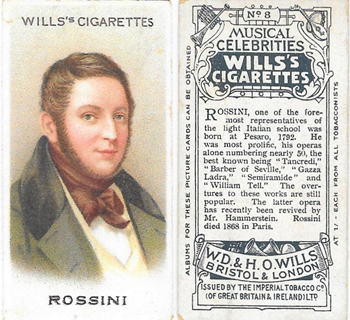


Gioachino Rossini (1792-1868), pictured above on Wills's Cigarettes Musical Celebrities No 8 1912, composed 39 operas including The Barber of Seville, William Tell, and Le Comte Ory.


Giuseppe Verdi (1813-1901), pictured above on Ogden's 'Guinea Gold' Cigarettes No 63 c 1901, composed Rigoletto, La Forza Del Destino and Otello among his 25 operas.  The back of the card is blank.


Early Innings—Chicago’s affair with base ball took a little longer to blossom.  Schoolboys had played barehanded games of bat and ball in America from colonial times.  A still gloveless but more mature and regulated brand of the recreation emerged in New York City during the 1840s.   Partisans gave it the two-word name, Base Ball, and wrote a rulebook.  The entertainment soon spread from the boroughs to other Eastern cities but was slow making its way west.  In 1863, the number of diamonds in Illinois could probably be counted on one hand.   A small scattering of amateur clubs practiced the game in Chicago and only the Empire Base Ball Club in Freeport tended to the sport outside the city.  That summer, the Empires challenged any of the big city clubs to play for an Illinois championship.  Chicago’s Garden City club accepted the invitation and fell to the Empires in a politely-disputed three-game series.


Base Ball was wildly popular across the upper Midwest in the years following the end of the Civil War.  This handbill is an example of the new game’s enthusiasm.  It advertises an 1867 match between the doctors and lawyers of Beloit, Wisconsin, describing the sport as The Best Thing Yet, and confidently promotes an admission fee of 10 cents for the event.


Excelsiors—The end of the Civil War allowed the game to flourish in Chicago.  Hailing the exercise as a superior refreshment for mind, body and soul, the Tribune stamped its approval on base ball’s local growth:


In this city at least 500 young men, many of them members of the “first families,” and all of the respectable class, are members of different clubs whose headquarters and batting grounds dot the city in all directions…Everywhere the game is a decided institution.


There was also the city’s reputation to consider, and the nagging matter of the state crown, still jealously held.by the stubborn Empires of Freeport.


In 1866, the Chicago Excelsiors rose to the top of that city’s base ball rankings, based in in part on its wealthy pedigree, maintaining a fashionable office downtown and a practice field on Lake and May.  But the team proved its worth on the diamonds that season, knocking the Freeports off their perch to start the year and then defeating a Detroit ball club in a memorable match that concluded a tournament for the Midwestern championship in June.  Detroit complained about its loss for decades.  In a 1903 interview, Detroit right fielder David Barry said:


The umpire beat us.  He allowed the Chicago pitcher to ‘bowl’—use a slight overhand motion in delivering the ball.  Everybody knows we had to deliver the ball underhand those days.  The advantage their pitcher had over us was enough to win the game.


That old grudge rankles deeply in our hearts yet.


The Excelsiors ended the year by winning the first-place prize in a September tournament, besting a brace of well-respected St. Louis clubs along the way and then dispatching the rival Chicago Atlantics in a hard-fought showdown. 


Dodging insistent invitations from Detroit for a rematch, the Excelsiors finished their campaign without a loss, kings of the game from the banks of the Mississippi River to the shores of Lake Erie, and the unblemished record had a certain ring to it, and it made a certain noise.  It sounded like music. 


 ---Russell Streur 


Thank you for reading! Happy Collecting!

And thank you Russell!

NEXT FRIDAY: 1981: Part 1.....things are gonna get sticky around here. That's right, I'm talking the 1981 Topps Baseball Stickers...and album.

Friday, November 5, 2021

FOMO, 1987 Fleer, 2021 Topps Update, and Having a Round with the Examined Life


As a returning sports card collector, I learned a new acronym.

            FOMO

            Fear of missing out.

            Believe it or not, I’d never heard that phrase/acronym/whatever-you-want-to-call-it, before I began collecting again. Then there it was. On card podcasts. In collector’s feeds. FOMO. Fear of missing out. Usually, it was attributed to the inability to buy a card product that other collector’s had access to and they wanted. Or it was a product that said collector wasn’t really into, but was going to buy anyway because they didn’t want to be left out of the experience of opening that particular release, or be unable to participate in a discussion over a product.

            FOMO.

            Fear of missing out.

            Like everytime i see this.

            
            I’ve been going through a bit of an existential crisis as a collector these last few months. Or maybe this whole time. They say the un-examined life isn’t worth living. I say, the over-examined life is a pain in the ass sometimes.

            Yet there I was with my thoughts.

What kind of a collector am I? What’s this all about? I bought nearly every new release in 2020 and I still was confused. I thought buying less product in 2021 would help me (it certainly helped my financial bottom line) figure it out. I’m a flagship man and nothing else. Or, wait, I’m a Heritage collector too! Ah, but Stadium Club sure does look nice this year! How about them gypsy queens?

No…it’s chrome, chrome, chrome all the time.

            When in the hell is Big League coming out?

            I don’t know if part of this malaise is FOMO, or me just being a confused old man. I wasn’t exactly jealous of another collector opening product. Typically, I felt happy for them when they pulled something they liked. It wasn’t always this way. As a kid I had huge card FOMO. I remember Dimitri Danielopoulus showing up like clockwork every year with new cards, the punk. And then me being frantic trying to find them in every chain pharmacy I went into. Or Phineas. How he always seemed to have the latest Fleer and Donruss cards, when I was usually stuck with Topps.

            Oh, I’ve been to FOMO town and I’ve shook the FOMO down.

            But as an adult?

FOMO feels more like compulsion as an adult, rather than the fear of missing out. But still…it exists. I tried to quell that compulsion to buy product, by sticking with Flagship, and buying the cards of the players that I wanted from the other products. I’d wait for a release, watch as other collectors had fun opening said product, and then I’d buy the players I wanted on the secondary market.

There.

No need to feel jealous of anyone.

If I was, in fact, jealous.

But doing this presented another problem for me.

Who do I collect?

And why?

            I don’t want to slag off fandom and admiration for talent, but as a forty-seven-year-old collector, it takes a lot for me to get excited ripping a pack of cards and pulling out cards for kids who are twenty to twenty-five-years old. Yeah, Vlady Jr. is good. Great maybe. But I could be his dad. There’s no mystique in the card of a twenty-two-year-old kid. There’s nothing aspirational for me.

I’m not being a crank.

I swear.

I’m just not as enamored as I would be if I were thirteen-years-old, like I was back in 1987, and I was hunting for a Barry Bonds or Bobby Bonilla rookie card.

            Ah, 1987.

            Some of you out there remember 1987.

            I sure do.

            Alyssa Milano’s image plastered to my wall. The Bangles Walking like Egyptians on MTV. Michael Jackson back on the airwaves, being “bad” in a way that still seemed innocent. Madonna box office bombs. But Madonna hot as hell. Reagan and Gorby meeting and cooling that Cold War. Punching out Mike Tyson on Nintendo. The Lost Boys on the silver screen, and Stand by Me playing constantly on HBO.

            And, of course, the baseball cards.


            I think I’ve more than expressed my infinity for all 1987 baseball card products. If collectors have a wheelhouse year, then 1987 sure as hell is mine. Topps, Donruss and Fleer did no wrong in 1987 in my humble opinion. The designs are brilliant. My memories are brilliant. Summer nights sitting on my bed in my room, going trough packs and boxes of those cards. Nights where all it seemed you needed was a fan, instead of the a/c blasting from May until October. No pressures. No fears. No real problems.

            Just gazing lovingly at those cardboard works of art.

            I’m being generically idyllic for the purposes of this blog. Thirteen-year-olds have plenty of pressures, fears and problems. They have tons of FOMO. Lord knows I had my share of mine. But sitting here as an adult those problems seem intangible. They were trifles. Or issues that I was able to surmount. Suppress.

Now…you sit here aging. There are work issues. Kowtowing to supervisors. Feeling like you live at a job. Family issues. Sick parents. Aging parents. Not seeing your family enough because of a fucking job. Keeping a roof over your head issues. Global issues that scare the living piss out of you. And no matter what it was back then that gave you anxiety, surely it had to be better than what’s keeping you up now.

            I have FOMO for my youth, if that’s possible.

            This brings me back to my current collecting malaise. When I began collecting again, a major part of it was to collect the cards of my youth. It was those cards, more than opening current packs full of twenty-year-olds, that was going to be my modus operandi. But shit happens. I forgot how The Hobby just pulls you in. And I ended up doing both.

            And it’s kind of worked out.

I’m of the Junk Wax Era, so the cards, even in wax box form, were still plentiful and cheap. I had a nice symbiosis of buying both the old and the new. Until 2020 hit. And everyone became a collector again. And prices shot up. On everything. Even the Junk Wax. To ridiculous extremes that it didn’t even feel like FOMO if you didn’t buy a product you wanted, but just good financial sense.

As for the rise in Junk Wax Era wax boxes? I had bought most of what I’d wanted/been able to buy in wax box form, and had a good portion of the Junk Wax sets that I loved, completed, before the spike. But the rise in costs made basically buying anything older than 1986 impossible and, to be frank, a foolish endeavor. $600-$800 for a wax box of 1985 Topps baseball cards? That was enough to make me curse card graders. I refused to buy those products and I refused to feel any FOMO over it.

            Except for one.

            1987 Fleer.

            1987 Fleer baseball is the one product that seemed to always borderline in terms of cost. I’m a cheapskate at heart. So, back in 2019, when I was buying boxes of 1987 Topps and Donruss for what I still considered very reasonable prices, 1987 Fleer hung back there at $50-$60 dollars a box. My logic back then was a such: Fifty-dollars a box? For Junk Wax! I don’t care how beautiful those cards are, I’m not paying $50 for a box of 1987 Fleer.

            Dumbass.

            April 2020 was the last time I saw 1987 Fleer baseball cards at any price I personally considered reasonable. By the end of 2020, 1987 Fleer was hovering around $150 for a wax box from a sealed case. As of this writing in November 2021, 1987 Fleer wax boxes from sealed cases are going for around $195.

            And it doesn’t look like they’re ever going to come down.

            I’ve been harboring some serious FOMO over 1987 Fleer baseball cards for a long time.

            The heart wants what it wants.

            Although the heart can take a hike at $195 a wax box.

            Topps 2021 Update is coming out. Or its fully out by the time the three of you read this. Though I was never a Traded set fan as a kid, and I’m not really an Update fan, I resolved to buy the product in both 2019 and 2020. FOMO, right? Or I considered it a part of the Flagship project, and no set would be complete without the addition of cards U-1 to U-300 (or U-330 now).

2019 Update has some good stuff in it.


The less said about 2020 Update the better.

But my reasoning for not really liking Topps Update is pretty simple.

            I feel ripped-off buying it.

            I never felt the need to have an all-star card for every single player that played in the game (yes, I know they’re inserts this year). Or having home run derby cards. There are too many team-related cards in Update. Full disclosure, I don’t like team cards or league-leader cards. They take up space that could be used for more regular player cards. 

            Though I will admit that having rookie cards of some late call ups is a cool thing, especially if its someone like this.


But do we really need all of these “rookie debut” cards?

Seems like a ploy on Topps’ part to make a second rookie card.

            Although I guess we won’t be worrying about Topps pretty soon.

            The collecting world could go back to a 132-card Traded set and be fine


Despite my protestations, I was poised to buy 2021 Topps Update. Even though I wasn’t wowed by the checklist, I was ready to drop another $220 (rounded up) to buy another two hobby boxes of the product to put together a set, and keep some doubles for my schizophrenic PC. And, you know, get another two relic cards (I never get autos in any flagship product) of a piece of a uniform from some kid I didn’t care about. And get insert cards of players that I didn’t care about. Or get gold cards and/or parallel cards of players I didn’t care about.

            There’s a pattern here.

            I didn’t want to buy 2021 Topps Update, but I had a fear of missing out if I didn’t. FOMO. And I didn’t particularly like that about myself. It brought me back to those Dimitri Danielopoulus and Phineas days. If I’m going to invest time and money in something I collect, I want there to be joy involved. The feeling like I had as a kid. Like back when I was thirteen. Alyssa Milano smiling at me from my wall. Vern and Gordy on TV running from a train, while I leafed through stacks of cards. Michael Jackson’s new single on the tape deck.

            Can’t repeat the past? Why, of course you can!

            (If I accomplish nothing else on this blog, I’ll be satisfied if I make someone pick up The Great Gatsby and give it a re-read)

            I found myself on Baseball Card Exchange during a lull at the job. I was looking at cards from the 1980s, as I’m apt to do. The stuff from 1980-1985 that have become pipe dream purchases. The stuff from 1986 that, well, if I wasn’t buying current product…maybe? As always, I landed on 1987. And there were those Fleer wax boxes. The ones that were once $50 and are now $195 dollars. I sighed at my previous stupidity and cheapness.

            But.

            On the BBC Exchange site there was a box of 1987 Fleer baseball cello packs going for $130. That’s not $200, I thought. That’s damned near…reasonable? It’s not, considering what the sets and singles of star cars are actually worth. At least worth raw. But what’s logic in the throws of capitalism? I wanted that cello box of 1987 Fleer baseball more than I wanted anything, save a handful of cards, from 2021 Update. I made a deal with myself right then and there. I’d buy one box of the 1987 Fleer cello packs and skip out on 2021 Topps update altogether.

            I bought it right then and there.

            Jay Gatsby was ultimately wrong. You can’t repeat the past. No matter what you do everything is forward motion, until we meet our ultimate fate. Can’t repeat the past? Nope. But for a good hour or two you can invoke the past. And that’s how I felt when those 1987 Fleer Baseball cards arrived, and I set up to open them. I didn’t feel thirteen. I wasn’t going to run-off with Alyssa Milano when she came knocking on my door and admitted her love for me, as I fully expected her to do some thirty-four years ago.

            But I was going to have some fun.

            Some real fun.

            And fun I had. First of all, the cards themselves are goddamned gorgeous. If one can call a baseball card set gorgeous. 


            They have those icy blue borders that fade into white, only for the ice-blue to return again. The pictures of the players are sharp. And 3-D. 1987 Fleer, and feel free to correct me on this, is probably the first base-set to have a portion of the photograph come into the border area. I always say that of the three in 1987, Topps will be my forever favorite. And then I see a Fleer card. And I just don’t know. I just don’t know.

            With Junk Wax Era cards, one always had to worry that the packs may have been tampered with. Wax packs especially. While this cello box wasn’t from a sealed case, it was what the BBC Exchange classifies as a BBCE, which, I think, means that most likely the box is as it should be. But there’s still always a worry.

            Yet when I opened it, this guy was staring back at me.


            And I thought maybe all would be right in the world.

            Half-way through the first cello pack, this guy’s rookie card showed up too.


            For the record, every single one of Bo Jackson’s 1987 rookie cards is an absolute work of art.


            It only took a couple more packs for this one to show up.


            I don’t think I can explain how wide my smile was when I pulled that.

            It was like being thirteen.

            Speaking of, the thirteen-yea-old in me would’ve wrestled someone (Phineas) to the ground had we both stumbled upon this cello pack in a store.


            Then there’s your standard, garden-variety Fleer ink errors.


            Yeah…the Nolan Ryan card.

            But it was still an improvement for Greg Minton over this.

            About half-way through the cello box is where a lot of those Junk Wax Era doubles started showing up. It’s great when it’s Pete Rose or Reggie Jackson, but not so much when its Juan Bonilla. Plus, I still hadn’t pulled the Barry Bonds rookie yet. Half-way though the box and he hadn’t shown. I was starting to get worried.

            Then this happened.


            And two cello packs later a second one arrived.


            Inserts 1987 style.


            And look at this rouge’s gallery.


            Back then I hated everyone in that picture.

            Now I PC three of them.

            1987 Product was the last time I’d see this logo on anything.


            Last but not least, the bottom of the cello box.


            Opening 1987 Fleer baseball was an absolute joy. It brought me back to being a kid, and everything I loved about cards and collecting. Yeah, it cost me more. But I do plan on building the 1987 Fleer sets and I managed to get a good number of doubles of players I collect. To hell with FOMO over current product!

That morning I said to myself, this is what collecting is all about. This is what collecting should be for a guy like me. Why buy a box of 2021 Topps Update? Or even 2022 Flagship next year, when I can spend my card money opening up a box of 1986 Fleer. Or Donruss. Find those Jose Canseco rookies.

            And find that spark.

            That joy.

            Man, I’d finally done it!

            Overcome my existential card dread!

            The examined life truly was worth living!

            But then I went online and watched a dude open up a jumbo box of 2021 Topps Update.

            Then the checklist for 2021 Archives came out.

            And I was back in FOMO town all over again.

            Damn.


Thanks for reading! Happy Collecting!

Because I feel bad for slagging him, f you’d like to know more about the life and career of Juan Bonilla you can do so HERE and HERE.

NEXT FRIDAY: Russell Streur returns with a look at Music to the Ears: Opera and Base Ball Come to Old Chicago.


Friday, October 29, 2021

Jose Cardenal and the Shakespearian Tragedy of buying cards from the 1970s.


I like the image on this 1976 Jose Cardenal card.

            It’s crisp. It’s sharp. It’s a nice close-up of Jose holding the bat in his Cubs uniform. The design of 1976 Topps has always been one of my favorite designs as well. They left a good amount of room for the player photo, but were still able to get creative with the color border. That double bar design really stands out for me. And even more than Topps’ 1973 brand, I think 1976 gets that little player cartoon right as well.

            Topps finally mastered clearer action shots in 1976.


            And this might be in my Top 10 favorite cards of all-time.

            In fact, I’d put 1976 Topps up there as one of my favorite designs of the 1970s, and quite possibly one of my favorite Topps Baseball designs of all-time.

            There’s a simplicity to it.

            1976 is a classic baseball card.

            1976 is probably why I’m a big fan of these.


            But.

            And there’s always a “but” here on Junk Wax Jay.

            1976 Topps, that Jose Cardenal card in particular, are a part of one of my most embarrassing scenes ever in The Hobby.

            Even more embarrassing than this one.

            Let’s start at the beginning of this sordid tale, shall we?

            You collectors remember being a kid, right? Especially a kid that has a little bit of money that’s burning a hole in his/her/their wallet, and the fire can only be quelled by buying some cards. A pack. Maybe some singles at a local LCS. Whatever gets the money out of your wallet and the cards into your hand. Those days when capitalism smelt like wax, cardboard and gum.

            It’s a great feeling.

            But it can lead you down a dark path.

            When we were kids, it seemed like card shops were popping up everywhere. In malls. In some dude’s basement. In the suburb I lived in, we had a lot of strip malls. Those low-rise sets of buildings all strung together. Usually there’d be a laundry in one. A mom-and-pop pizza joint. Maybe a chain pharmacy. Some independent tax guy with a little cash for a legit store front.

            And then a card shop.

            We had this one card shop in a strip mall right past where Frankstown Road met Duff Road, and the glorious McDonald’s beckoned us for an after card shop treat. It wasn’t really a card shop per se. The guy sold jewelry. Gold chains and the like. He’d obviously added the card stuff to try and latch on to the current zeitgeist. As I remember him, the proprietor of the jewelry/sports card store was a short, seedy man with a pencil-thin moustache. He wore sunglasses indoors and had a toothpick in his mouth. Had too many buttons on his shirt open.

            Or Tony Clifton 

            
           Or maybe that’s how I want to remember him.

            Seedy.

            Sinister.

            Mr. Sinister.

            This “card shop” was a lot closer to our homes than heading out to the mall, so it was easier to convince mom to take us to the shop and sit in the car and read, while we pursued our happiness, indulged our bubble-gum bliss. And the card shop wasn’t much. Mr. Sinister had some product under showcases. The ubiquitous cards of retired heroes that he'd dug up from his own collection, or pilfered from some widow while ripping her off of her family heirlooms. The cards none of us could afford. I remember he didn’t have current product. There were no Topps, Fleer or Donruss packs for us to buy. No cards of current stars.

This was a jewelry store fronting as a card shop, after all.

If this guy had distribution channels it wasn’t with the card companies

More like some guy named Vinnie or Tony who carried around black briefcases full of jewels.

But what Mr. Sinister did have, and what was equally intriguing to us kids back then, was shoebox after shoebox of commons from the 1970s.

I don’t know if younger collectors have a fascination with older cards. I don’t know if there are young collectors out there. Or what constitutes an older card these days.

2001 Topps is twenty years old.

Does this look ancient to you?


When we were kids, and I say we, because my brother and Miller were with me on this fateful, embarrassing day (let’s say it’s 1985), cards from the 1970s were only six to fifteen years old. We were all born in the 1970s. At least two of us had memories from the 70s. The 1970s felt tangible yet distant at the same time.

The cards from that era; they were something we could have.

This guy's legend was still tangible.


Hell, I'd seen him play...and not just in a Naked Gun movie.

It didn’t matter if they were star cards or commons, we wanted those 1970s (and 1960s and 1950s). I remember going to Mr. Sinister on different occasions and going through box after box, pulling out cards from the 1970s that just looked cool, having no real clue who the players were. There were stats on the back. I’d figure that one out later. Then I’d have a small pile of 1978s. Or 1977s. Cards that were maybe a dime a piece at the time.

I learned a lot about baseball from buying those older cards.

And Mr. Sinister? I wouldn’t say he was kind or benevolent. He looked unused to kids being anywhere near his store. Annoyed at times. I don’t know who he thought he was attracting by opening up his shop to sports cards. I’d say, at best, he was tolerant of us. Cigarette hanging out of his mouth, he’d slowly get up to fetch whatever shoebox of baseball lore we wanted to look through next.

He was a faceless lacky.

The conduit to our pleasure in commerce.

Until he didn’t want to do it anymore.

I was Mr. Sinister’s breaking point. Truthfully, I don’t even know what caused it that day. Maybe I had extra money and wanted to peruse more. Asked to look at more boxes than I should’ve. It was the summer. It was hot. Mr. Sinister’s store didn’t have air conditioning and his toupee looked flat and wet. It was hot enough that my mom was inside the shop, instead of waiting in the car.

What happened was simple.

I asked to look at another box of cards.

Mr. Sinister said no.

I was taken aback. Not in a pompous, privileged way. It’s just us kids weren’t used to being told no when it came to buying cards. Not by guys at card shows. Not by the poor clerks in the American Coin who we terrorized on a regular basis. Not by guys like Mr. Sinister. 

No? What was no? No didn’t exist when there was money involved. They didn’t tell you no in line at the Giant Eagle supermarket. No one said no in the kid’s clothing section of Kaufmann’s department store. What in the hell did this guy mean by saying no?

Mr. Sinister said no.

Mr. Sinister said I’m done.

I showed him my fistful of crinkled bills, just in case he forgot what a functioning and fruitful capitalistic system looked like.

Mr. Sinister pointed to the small pile of cards that I had selected.

He said you’ve been in here for almost an hour, and maybe you’ve spent a buck.

You kids are done.

Done? I thought. An hour? I pieced together time. Maybe it wasn’t the heat. Maybe my mom was in the store because she’d been wondering what was taking us so long. Maybe Mr. Sinister looked haggard because he’d been pulling down box after box of cards for three kids armed with little more than pocket change.

Miller and my brother were standing there like they'd been waiting on me.

I looked down at my cards and there was the 1976 Jose Cardenal on top.

But, I said, looking up at Mr. Sinister.

You’ve been here long enough, my mom said.

Et tu Brute!

Done, Mr. Sinister said.

But, I said. My lip began to quiver. Just one more box?

The 1975s?

The 1974s?

I don’t think I got to see the 1979s.

Done.

It hit me that I wasn’t going to get to look at anymore cards that day. That the small pile I had selected was it for me. Jose Cardenal? Who in the fuck was he? I couldn’t not understand the strange turn of events. That turncoat, Mr. Sinister? Didn’t he understand? Money talked. Bullshit walked a marathon. I had money. I was a paying customer. The customer was always right. Right? Now go and fetch me another goddamned box of cards!

Done.

What happened next was out of character for me. I was a fat kid and usually acted accordingly. I was wallpaper. I didn’t try to stand out. But that day I could feel it coming. The anger rising. The bile. The violent hatred I felt toward Mr. Sinister and his cheap, two-bit, half-assed card shop, pawned jewelry, whatever, strip-mall storefront. I wanted to lash out. Wanted to tell that greaseball the suck it. But I couldn’t. I could lash out the only way an eleven-year-old was able to when confronted with belligerent adults.

I began to cry.

And whine.

And stamp my feet and throw a tantrum.

And demand.

I demanded he show me another box of cards.

Mr. Sinister was unmovable. My mom embarrassed. My brother and Miller; their mouths were agape at the Shakespearian tragedy playing out before them. I was hauled into the car. I wasn’t even allowed to buy the cards I had selected. So long Jose Cardenal.

I was left to sit in the front seat and cry, while my mother went back in that bastard’s store, so that my brother and Miller could pay for the cards that they’d selected. I was left alone with my misery and anger and embarassment. I think I vowed then and there to burn that goddamned fake-ass card store to the ground.

I sure as shit was never stepping foot in there again.

            We drove home in complete silence save the whimpering from my self-pity.

            We didn’t even stop at the McDonald’s that so prominently stood at the intersection of Frankstown and Duff.

            That was my fault too.

            There is no creature loves me; And if I die, no soul will pity me.

            And I spent the rest of the afternoon alone in my room.

           If we can escape my shame for a moment, I do want to stress how much I realty love the 1976 baseball card set. I’m enamored with its simplicity. I seem to like it more and more each time I see it. To some collectors 1976 pales, and is probably one of the least exciting sets of a pretty colorful decade. And other than Dennis Eckersley, there isn’t much of a rookie class; though Ron Guidry and Willie Randolph are no slouches. To each their own.

            But the 1976 set has some great stuff.

            It has this guy’s last card.


            And the second cards for these three hall-of-famers.


            Last spring, I ended up finding a 150-card lot of 1976 cards and thought what the hell? So I’ve started slowly piecing together the set. Buying some star cards on the cheap. A few commons here and there. I’m hoping to get to a card show early next year, and maybe there I’ll get some more of them in bulk. Buy that Jose Cardenal for old times’ sake.

            Only this time…no drama.

Thanks for reading! Happy collecting!

If you'd like to learn more about the 1976 Topps baseball card set, you can do so HERE

If you'd like to learn more about the career of my boy, Jose Cardenal, you can do so HERE and HERE

NEXT FRIDAY:  I'm going to celebrate the release of 2021 Topps Update....but talking about 1987 Fleer.


Card Show....yeah.