Friday, July 15, 2022

1986 Pittsburgh Pirates and Transitional Team Sets or Where Have You Gone, Sixto Lezcano


I’m not a religious man by any stretch of the word.

            But there’s a joke that I appreciate.

            It goes like this:

            How do you make God laugh?

            ….

            Make a plan.

            I had planned on doing a pot pourri baseball card blog post this week. What that meant to entail was me actually going to an LCS here in Brooklyn (and by LCS I mean a sporting goods shop that sells older packs of cards), buying some random packs, and then talking about them on Junk Wax Jay.

            For whatever reason (work, heat, laziness) that didn’t happen.

            There almost wasn’t a blog post this week.

            But then something happened.

            Some one on Twitter posted their copy of this card.


            He’d had the card signed by Sixto Lezcano and was showing it off in his Twitter feed. That’s not to say there aren’t die-hard Sixto fans out there. I’ve come across a few. It’s cool being a fan of those random players, not top-tier, not even second tier, from your favorite team.

            I happily celebrated this guy’s birthday this week.


            Seeing the Lezcano card got me thinking about the 1986 Pirates team sets. The Topps one in particular, but this blog post can also be subscribed to the 1986 Fleer and Donruss team sets. The Lezcano card got me thinking about how much the 1986 team sets were transitional sets. What I mean by ‘transitional” is that it’s a team set that bridges the gap from one era of a team to another era. In the case of my 1986 Pirates team set, it bridges the gap from the remnants of the 1979 World Series team to the beginning of the era that brought about the 1990-1992 NL East Champion teams.

            But first let’s go back a year to 1985.

            The 1985 Pirates team sets still had a good number of players left who played on the 1979 World Series champion team.


            Not including manager Chuck Tanner, the number would be seven.

            By 1986 that number would be dwindled down to two players.


            With the loss of those members of the Fam-I-Lee, the 1986 Pirates team set is made up of some players who hung on with the team throughout the early into mid-1980s, but never really excited me as a team collector, or a fan.

            Guys like these.


            You get a rookie or so with the team, trying to make it.


            A couple of mainstays on all-star teams of the era.


            Seeds of a new dawn.


            But a decent part of the team set is made up by a number of players who came aboard the Pirates ship in 1985 to try and reverse the fortunes of a team that was rapidly declining in the mid-1980s. You know the kind of players I’m talking about. Guys hanging around the end of their careers, hoping to get one more decent season out of their bodies, or maybe one more paycheck from a team willing to take a chance.

            Guys like these.


            The Pirates finished a dismal 57-104 in 1985.

            Sixto Lezcano would be out of baseball after that season stuck in Pittsburgh.

            Steve Kemp and Johnnie LeMaster would soon follow.

            With the exception of Kemp (albeit briefly) none of these “ringers” would be on the 1986 Pittsburgh Pirates.

            One of them didn’t even make it beyond the 1985 Traded Set.


            Transitional for sure.

            It’s not like the fortunes changed much for the Pirates in 1986. They were 64-98 and pretty bad.

            Some of the guys from the 1986 set were still hanging around.

            But there was a new manager bringing life to the team.


            And this guy made his debut in late May of that year.


            This World Series Champion was back in the Big Leagues to stay in 1986, after playing parts of the previous few seasons.


            All 1986 Traded cards, of course.

           Those transitional 1986 Pittsburgh Pirates team sets can seem a bit dull on the surface. 1986 might’ve been the first time I was excited more for the product on the field than the actual cards that I was pulling from packs. But I’ve grown fond of the ’86 team sets over the years. Fond of their oddity. Fond of their place in Pirates history, even if the 1985 team was somewhat of a black mark. Baseball in Pittsburgh in 1985 was a black mark…let’s not forget those drug trails, shall we?

            Transitional for sure.

            But the transitional often times leads into a new foundational.

            With the seeds planted in the 1987 team sets.


           And further solidified with some additions in 1988.


            By 1989 Pirates team sets would be full of players I’d root for and watch take three NL East championships. Sure, there were some random guys along the way. And the Pirates could never set away from giving a player on his last legs one of his last shots in Major League baseball.


            Gibson would actually play three more seasons in Detroit…I just love the strangeness of him on a Pirates card.

            I don't own any Gibson with the Pirates cards...something that NEEDS to change.

            On Pirates team sets from 1987-1992/1993, the players you’d pull would become commonplace. That same group of guys showing up year after year. Solid. A team you could count on. Like the Pirates team sets building up to and even after the 1979 World Series champion Pirates. The sets that had Madlock, Stargell, and Dave Parker headlining them. Mike Easler. Omar Moreno.

            The memories can go on and on.

            So I’ll take those 1986 Pittsburgh Pirates sets for the little weirdo sets they are.


Thanks for reading! Happy Collecting!


Friday, July 8, 2022

Non Sports Cards : Where Does He Get Those Wonderful Toys?


Here’s a story

            I’ve never been much of a non-sports collector. I don’t think it had anything to do with not liking non-sports cards. It mostly came down to money. And when you’re a kid (and often even as an adult) you don’t have a lot of money. Decisions must be made about how one spends their discretionary cash. Baseball cards vs. Star Wars cards. Baseball cards vs. a comic book. If I had enough money (usually a birthday or after Christmas), it was this action figure vs. that action figure.

            Choices had to made.

            In the realm of collecting, it was an obvious and easy choice that I was going to pick sports cards over any other kind of card, be it a Batman card or Star Wars card, or any other kind of non-sports card. Aside from a lack of cash, I usually had other means of representing my interests in those areas of entertainment. Action figures usually covered the gamut from space adventures to superheroes for me. There was nothing I wanted more, toy-wise, than action figures. For years they filled every birthday and Christmas wish list, and if I found myself with a decent bit of cash, there was usually a sports card/action figure split in how I spent it.

            See, I didn’t dislike non-sports cards.

            I just never had any room for them.

            In fact, there are only two occasions that I can think of where I sought out the buying of non-sports cards. The first was the Return of the Jedi cards Topps produced in 1983. Collecting those happened by accident…and via competition. I’ve talked about my friend Phineas on here before. Phineas always seemed to get the cards I wanted. The action figures I wanted. There was a time in my life wherein I thought Phineas had all of the good luck, and I had all of the bad.

            Phineas had this card.


            He made such a big deal about it, that I wanted it.

            It was like the damned Shigeru Takada card all over again!

            So, I found myself buying Return of the Jedi cards. Found myself bypassing (for a time) whatever sports card offerings the candy aisle had for me at my local Thrift Drug, the buy Return of the Jedi card. I ripped dozens upon dozens of packs trying to get that Time Out for Love card. Of course, I never got it.

            Phineas: 1

            Me: 0

            The other time I really got into non-sports cards was in 1991 with the release of the Pro Set Super Stars Musicard. I remember finding them at Phantom of the Attic comic shop when I’d go there with some of my comic book collecting buddies. They had them right at the counter. I was lured in by those very 1990s hot color packaging. And the cards were pretty cool too. They fit my aesthetic at the time. I was seventeen. I was buying a ton of music. I was slowly moving away from sports cards.

            I managed to pick up some in my return to collecting a while ago.


            Recently, the non-sports bug has been knowing at me a little bit. I think it might have something to do with this entertainment nostalgia phase I’ve been going through. I mentioned that a few weeks ago on the blog. Brady Bunch stuff. Batman stuff. Well, along with that I was getting me a good card purchasing itch. Fill-in some gaps on players I collect, that kind of thing. I figured maybe I could check out ComC and see what they had out there in the non-sports selections for some of the stuff I’ve been getting myself back into lately.

            I wasn’t disappointed.

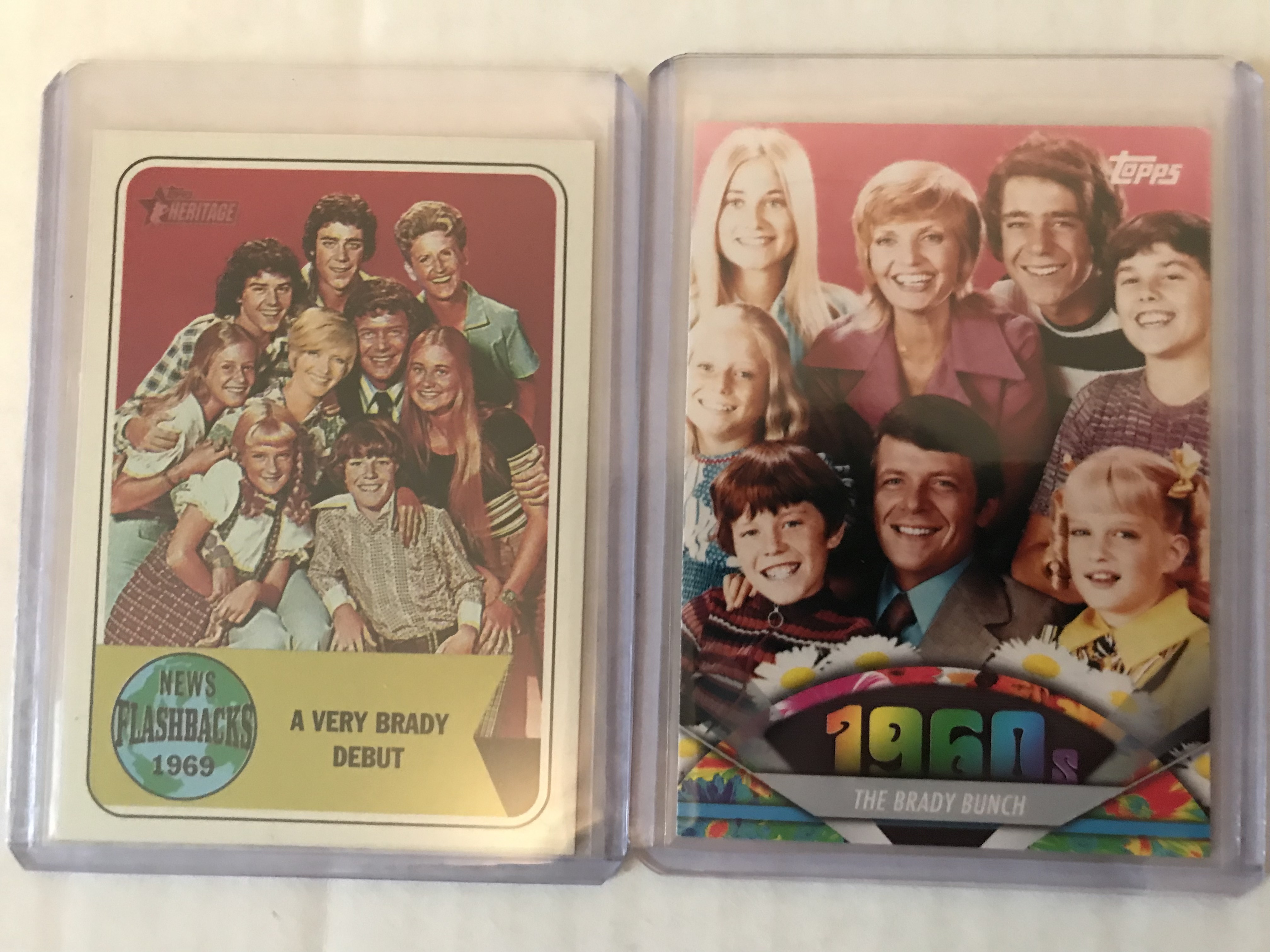
            The first thing I grabbed were these.


            Now, ComC had a few of the cards that were originally released with the Brady Bunch series…but they were a little too rich for my blood. The Topps 2018 Flashback and Topps 2011 American Pie cards did the trick at an affordable price. I haven’t been too big a fan of the Flashback cards, generally finding them as annoying as the other inserts Topps throws into Heritage every year. But occasionally I come across ones I like. Most notably the Willy Wonka one from the 2020 Heritage set, which has to distinction of being the only card my wife owns.

            The American Pie cards from 2011, though...man, I wish I’d been around for that set! From what I understand it was a relaunch of the 2001 Topps American Pie set, only with a focus more on entertainment and pop culture as opposed to also including historical and/or political events as well. The set seems to run decade by decade highlighting the bits of culture that shaped each decade.

            Aside from the Brady Bunch card, I found this.


            Yes, you’re right, it’s a Jack Kerouac rookie card!

            Being the massive Kerouac fan that I am I snagged that one immediately. I’ve been a fan of Kerouac’s work for as long as I can remember. To say his writing shaped my worldview of art and what art could be…well…that would be a massive understatement. There was a time in my life where his words were bible to me. I’d read his novel like a devout zealot. When kids were wearing flannels in the 1990s, because of Kurt Cobain and Eddie Vedder, I was wearing them because of Jack Kerouac.

            And I don’t think I’m done with this American Pie set.

            There’s a Muppets card and a Mister Rogers card out there with my name on it.

            The last two purchases I made were intentional.


            I’ve sort of decorated a corner of my writing space with Beatles items. An Abbey Road poster. Some photos of Beatle-related places that I’ve had the pleasure to visit. I thought it would be cool to put up something that melded my Beatles love with my love of card collecting. So, I grabbed that Beatles card. The idea was to take the card to a framer, have it mated, and then put the card up on the wall with the other items.

            But I didn’t stop there.

            If my love of the Fab Four is boundless, then my love of the Pre-Fab Four is equally as great. I’ve been happy to call myself a Monkees fan since 1986. A true-blue second wave fan who caught on with those Monkees marathons that MTV was showing. I knew that The Monkees had trading cards. I believe it was Donruss who put them out in 1967. And I also knew that The Monkees posed in a similar director’s chair fashion as The Beatles has previously done. Why of course they would! In a couple of clicks I found the card. The plan now is to get them mated and framed together.

            I do actually have two other Beatles cards, courtesy of my brother


            I now have a small cadre of non-sports card in my card collection. They skew very specific to who I am as a person. The issue now (because why shouldn’t there be an issue) is what to do with them? They feel like, even more so than my sports cards, that they should be displayed in some fashion. Maybe in stands on my writing desk, or in those new connecting frames that BCR is selling. I don’t feel like they should just go in a binder or sit in a box. Of course, neither should some of the sports cards I’d like to show off, if only to myself.

            Wouldn’t you know it, though…there was one card I forgot to buy in that purchase. One I’d been searching for since 1983. Yep, you guessed it.

            Phineas: 2

            Me: 0

            And I forgot to get a Batman card!

            Anyway...

Thanks for reading! Happy collecting!

Next Friday: its Pot Pourri time on Junk Wax Jay    


Thursday, June 30, 2022

MURDER IN THE MOONLIGHT: THE KILLINGS OF GEORGE TRUSSELL AND WILLIAM MCKEEVER, CHICAGO 1866 by Russell Streur

MURDER IN THE MOONLIGHT: THE KILLINGS OF GEORGE TRUSSELL AND WILLIAM MCKEEVER, CHICAGO 1866


George Trussell went to the track for some drinking and gambling on the Tuesday Mollie Cosgriff shot him dead.


September 4, 1866, was supposed to have been a big day for Trussell, but not that big.  He was half-owner of Dexter, one of the most famous and successful horses in America during its time, and the racer was scheduled to run in the Chicago Driving Park’s feature event that day, a $5,000 match against two of his biggest equine rivals—General Butler and George M. Patchen, Jr.   But thunderstorms drenched the city in the morning and the race was postponed.


Kinney Brothers Tobacco N231, American Trotters, 1889-1890 Dexter. 

Not just for baseball players, tobacco cards also featured other popular sports and subjects.


Trussell knew his horses, and he knew his gambling, too.  He made a fortune running one of Chicago’s biggest faro houses in the mid-1860s.


It was also said that Trussell knew his drinking.  One Chicago newspaper called the tall, slim 32-year-old a considerable addict to the spirits.


So it wasn’t a surprise that Trussell went to Seneca Wright’s tavern on Randolph Street around 10 p.m. for a nightcap and a song after an earlier tour of downtown bars with some of his sporting friends.


What was a surprise, was when Mollie Cosgriff showed up at the saloon, wanting a word or two with George.  She looked, according to one newspaper, as if she had just come from a dancing party, wearing a striking white moire dress to the occasion, a shawl draped over her shoulders, drunk, and carrying a revolver in a pocket. 


Mollie was no stranger to the tavern side of life.  She ran a well-known house of ill-repute on Fourth Avenue.


Mollie Cosgriff.  Aka Mollie Cosgrove, aka Mollie Trussell.

 Image:  Dedmon, Emmett, Fabulous Chicago, 1953, page 95


George and Mollie were no strangers to each other.  Mollie had fallen into the demi-monde in Chicago after moving to the city from her home in Ohio.   Her attractive figure and alluring beauty naturally gained the attention and affection of Chicago’s fast young men, and George was no exception.  An affair evolved, and a child by Mollie’s calculations.  The romance ended from George’s point of view, but Mollie never lost her devotion to the man and commonly used his last name as her own.


The lingering feelings were not reciprocal.  George didn’t feel much like talking with Mollie that night, and he tried to push her out the front door of the tavern.  Seneca Wright came from behind the bar and briefly separated the two.  Wright returned to his bartending.  Pushing and shoving resumed.  One witness said George struck Mollie.  Others said he didn’t.  Mollie pulled her gun and shot George in the left chest


George lurched back toward the center of the saloon.  Mollie followed, and fired again, the bullet striking him in the back.  George stumbled toward a side door of the saloon.  Mollie shot him a third time.  He staggered out the door, into the entrance of Price’s livery stable, and collapsed.


As if just coming out of a trance, Mollie raced out of the saloon and threw herself on her former lover’s body, shrieking frantically, “O my George!  My George!  He is dead.”


A notorious gambler and owner of a famous horse, killed in his prime.  A jilted lover, a keeper of a lewd house, a drunken murderess.  Newspapers across the Northeast quarter of the country followed the story with salacious glee.  It was a sensation, pure and simple, and it seemed like it would be a tough act to follow.  But Chicago was a tough town.


Racing resumed in the Windy City.  Dexter beat George M. Patchen, Jr. in the postponed $5,000 race.  General Butler returned to Chicago after a short absence, and a reporter for the Tribune took notice.


Lithograph (reproduction).  General Butler, Silas Rich, Bashaw Jr.


“There is great excitement in sporting circles,” the paper declared on Friday morning, September 21, 1866, “about the great race…between General Butler and Cooley, for a purse of five thousand dollars a side, and set for tomorrow on the track of the Chicago Driving Park Association.”


General Butler was a popular harness horse whose career overlapped the Civil War.  His likeness circulated on Currier & Ives and other lithographs.


Cooley was a black gelding and a favorite on Chicago race tracks.  Locally owned, the fast trotter was described as “a big little horse” with “an eye full of intelligence and kindness.” 


In 1865, Cooley and a consort Princess raced two runners from the Seneca Indian tribe named Deerfoot and Stevens for a purse of $1,000 at the Chicago Driving Park.  To even the duel, the horses were to run four miles; the Senecas two miles and twenty rods.  Cooley and Princess finished the relay in a total of 10 minutes and 53 seconds.  Deerfoot and Stevens completed their course 38 seconds ahead of the horses to rounds of cheers from the crowd.


Heavy betting underscored the excitement for the sulky race between General Butler and Cooley.  “The knowing ones seem to be about equally divided in opinion as far as odds are concerned,” the Tribune computed, “though the majority seem to think the General stands the best chance.”


The Tribune had its doubts whether the best-of-five heats showdown between the horses could actually happen.  Torrential rains had drenched the city, washing away railroad bridges, uprooting trees and costing a month’s wages to the city’s carpenters, bricklayers and other laborers.  The paper worried that the track would be too wet for the race.


Keeping an eye on the sky, the Tribune predicted the match would be one of the most exciting contests ever witnessed in the West if better weather held.


On Saturday, the soggy ground that troubled the Tribune prevented the city’s Excelsior and Atlantic base ball clubs from playing a trophy match to cap an Illinois tournament.  But by mid-afternoon, the cinder track at the Driving Park was dry enough to run.  And, unfortunately, the Tribune’s prophecy came true.


The match between the horses was also a match between the drivers of the sulkies they pulled.  Manager Bill Riley drove Cooley.  Two men would steer General Butler that afternoon—jockey Samuel Crooks for the first two races, and quarter-owner William McKeever the remainder of the way.


McKeever was a cool customer, and a good enough athlete to have played for two of New York City’s premier base ball clubs.  He began as an infielder with the Gotham club in 1859 before taking on pitching duties for the rough and tumble Mutual club in 1863. 


American Archives, Origins of Baseball (1994).  Fields of Play.

Top: Card 7, Elysian Fields in Hoboken, New Jersey, the ancestral grounds of the game.

Bottom: Card 18. Brooklyn versus Philadelphia.


The Origins of Baseball is a 100-card boxed collection that covers the sport from a woodcut of the game of Rounders dated to 1744 to  its mythical creation by Abner Doubleday in 1839 through sixty years of development to 1899.  The cards are excellently researched by Jonathan A. Mork and the set includes a special bibliography card.  Images are carefully balanced between players, teams and playing fields.  Individual cards can be found on ebay.  One recent full box set was priced at less than $25.  It’s a steal of home for the price.


Pitching was hard work in the brand of game played during the Civil War years.  Thrown underhand with the task of placing the ball over the center of the plate for the batter’s convenience, hurlers might throw hundreds of pitches during the course of a game.  Batters could wait for dozens to go by before selecting one to swing at. 


The great base ball clubs of Brooklyn.

Top: Card 16, The Atlantic Base Ball Club was considered the best team of the Civil War period. 

Bottom: Card 9. The Eckfords were just a step behind.


In 1861, McKeever pitched for New York against Brooklyn and the great Jim Creighton in the famous Clipper Silver Ball Match.  Creighton outpitched McKeever that day in Hoboken, but Creighton isn’t called great without a reason. 


James Creighton, Card 17.  The shadow of Jim Creighton hangs over the early years of base ball like a permanent eclipse of the sun.  The game’s first superstar, Creighton in his short career is often described as the sport’s best hitter and best pitcher.  In the fall of 1862, at the age 21 and seven months, he suffered an abdominal injury in a game and died from internal bleeding after four painful days.


Now nearing 30, McKeever had traded away the mound work for the less taxing pursuits of harness racing and gambling.  A half-hour delay after the scheduled start of the Driving Park match drew the disapproval of the crowd of thousands in attendance.  Odds favored Cooley 25 to 10 when the match finally began at 3:30 p.m.


General Butler pulled ahead in the first heat, building a five-length lead at the half-mile post but the horses were equal at the final turn.  A late surge by Cooley earned the win by a neck.


Cooley won the second heat by 15 lengths.  Bettors on General Butler, suspicious of the slow times turned in by Crooks and on the verge of seeing their wagers wiped out, begged McKeever to make a switch.  As the odds climbed to 100 to 25 on Cooley, McKeever took the lines for the third heat.  The move paid off with a win by 20 lengths for General Butler and the odds reversed themselves. 


Trouble began in the fourth heat.  McKeever appeared to cause six false starts in the handling of his horse and a half-an-hour was lost in fits and starts and ill-words between the drivers.  With darkness rapidly falling, the heat finally reached its start.  Two hundred yards into the race, McKeever suddenly swerved in front of Riley’s buggy, scraping Cooley’s nose.  General Butler won the race by a half-length.  Many in the crowd argued that the foul should have resulted in a dead heat, or the award of the race to Cooley.    Disarray prevailed when the track judges stuck with the win for General Butler.


By the time order was resolved, night had fully fallen and only moonlight illuminated the racing grounds.

More argument ensued, with half the crowd for the race to be called off due to darkness, and the other half demanding it continue.  A start was made despite the conditions.  General Butler broke in front along the rail as the horses disappeared in the darkness. 


In due course, Cooley returned to view, heading down the home stretch toward the winning line.  General Butler careened behind, without a driver.  A search quickly located McKeever, bloody and unconscious, face down in the cinders on the back stretch.  He was quickly carried to the home of J. R. Gore, a physician who lived nearby on Michigan Avenue.


Examination revealed extensive fractures to McKeever’s skull, with particular injury to the left temple, as if McKeever had been struck in the head by a hard object.  Gore extracted three broken pieces of the cranium.  Hopes were raised that the procedure would relieve pressure on the brain and allow McKeever to regain consciousness.  It soon became apparent that the patient could not recover from the injury. 


 With foul play evident, police launched an investigation.  After taking Riley into custody, suspicion fell on Tom and Peter Hickey, brothers who owned a saloon near the race track.  Police arrived at the saloon at two a.m. Sunday morning and arrested the brothers after a desperate fight that left the officers and suspects bitten, battered, billy-clubbed and pistol-whipped.


McKeever died Sunday afternoon without ever coming out of his coma. 


The Cook County Coroner opened an inquest on Monday.  The city’s sporting crowd packed the Central Police Station to view the proceedings.  A string of witnesses testified. Two said they saw Peter Hickey on the track between the fourth and fifth heat.  There were other figures in the shadows.


Man about town Seneca Wright said he heard Riley say in a nearby saloon after the third heat “I will win it or kill the damn son of a bitch.”  Wright said a man asked Riley in the saloon between the fourth and fifth heats if he was going to win the final leg.  Wright said Riley told the man “I have it all fixed.” 


Horace Yates was a track steward during the fifth heat.  He saw two men break off a board at the half-mile pole and cross to the inside of the track.  Darkness fell.  It was hard to see but Yates said the two men were still there for the fifth heat.  Yates said when the horses came along, General Butler was ahead by two or three lengths.  Yates saw McKeever fall.  McKeever was dragged 15 or 20 feet before the lines to the sulky slipped from his fingers.  Yates saw McKeever lying on the track, motionless and insensible.


Some men found pieces of a broken board on the track about 12 feet long.  The end of one piece had hair and blood on it.  Other men found a place in the race track fence where the board would fit.


On the second day of the inquest, Joseph Prednone said he was with Riley in the saloon before the fifth heat.  Prednone said Riley was drinking a good deal and was too drunk to safely drive.  There was bad feeling between Riley and McKeever, Prednone said, and if it came down to close driving, Prednone thought McKeever would get the worst of it.


Dr. Gore said the wound in McKeever’s left temple penetrated two inches into the brain and was the cause of death.  Shown the board, Dr. Gore said that it would be the most likely weapon to have caused the injury.


One witness said he heard men warn McKeever before the fifth heat. McKeever replied, “I can take care of myself.”


Riley sat in front of the jury on Friday night, September 28.   He was reminded he had the right to decline to answer any question that might incriminate himself.  Oath or not, Riley said he wanted to tell his side of the story. 


Not being sworn, Riley described the fatal moment.  Trailing the General by a length and a half after the turn, the jockey said he heard “a bit of a crash” and then someone call out, “Aha!  I have got you; you damn son of a bitch.” 


Seeing McKeever topple from his sulky, Riley moved away from the inner fence to avoid running him over.


Riley admitted to drinking before the heat but denied making any threats against McKeever or anyone else.


“I have never killed anybody,” Riley said, “and have never intended to.”


Riley denied any knowledge of a plot to obstruct General Butler during the heat.


“If I had heard of an arrangement to stop his horse, I would have warned him, and would not have started,” Riley said.


Riley closed with one admission.  “I did say, ‘If I could win the race, I would.’”


Tom Hickey denied any knowledge of the events surrounding McKeever’s death.


The jury returned its verdict on October, finding that a plot existed among unnamed friends of Cooley to prevent General Butler from winning the match, and that the result of this plot caused McKeever’s death.


Riley was released.  The Hickeys were charged with assault for their battle with the police on the night of their arrests.


A later history of the Chicago Police Department named Tom as the murderer. 


On October 10, the Driving Park Association banned all racing at the track and expelled Bill Riley for gross misconduct.  The owners of Cooley were also given the boot.   


It was too little, too late.  The reputation of the park was completely ruined by the murder.  It was sold at auction in December and soon demolished.


Turf Cigarerets, Card 9, Trotting and Pacing Races (1927)


Mollie Cosgriff went on trial that same month for the Trussell killing.  The charge was manslaughter, for which a sentence of up to life could be applied.  There was no argument that Cosgriff killed Trussell.  The only argument was whether she was justified in pulling the trigger, in fear for her own life when Trussell tried to push her out of Seneca Wright’s tavern.  The jury didn’t buy the bill of goods, but came close.  After deliberating just over three hours, the jury returned with a guilty verdict and the minimum sentence allowable, a year in the penitentiary.


It might be expected that a woman of Mollie’s notoriety and profession would have some connections.  In prison, she was given a private cell and allowed to receive visitors and wear her own clothes, but that was just a nickel ante in a smaller game.  Mollie had bigger cards to play:  she was pardoned by Illinois Governor Richard J. Oglesby after serving just a month of her sentence.  


In 1869, she was accused of running a house of prostitution in San Francisco.  The next year, she was reported to have gone insane.  Later, to be living among the Saints in Salt Lake City.  A reporter tracked her down, years later, in South Bend, Indiana, and asked her why she killed George.  Mollie reflected and answered a larger question.  “No mortal can endure but one hell in the world,” Mollie replied.  “That hell I have endured.”  Then she stood, took a seat at a piano, and began to play an aria from Lucrezia Borgia.


 Player’s Cigarettes, Famous Beauties (1937).  Card 8, Lucrezia Borgia.

 The series also included cards of Pocahontas, the Queen of Sheba, Nell Gwyn and other historical and fictional women of beauty and power.

---RUSSELL STREUR


Friday, June 24, 2022

Collecting by the Book : Or...Adventures in Reading/Where's LaVar Burton when you Need Him?


I become obsessed with things I’m obsessed with.

            That’s a funny sentence, isn’t it? But it’s kind of true. I get on kicks and the kicks go into overdrive and take up a good portion of my free time. Sometimes these are new obsessions. Most of the time, at least at my age, it’s reengaging with things that I loved in the past. A favorite TV show. A favorite superhero. A favorite Hobby, anyone?

            Here are two examples of what I’m talking about.

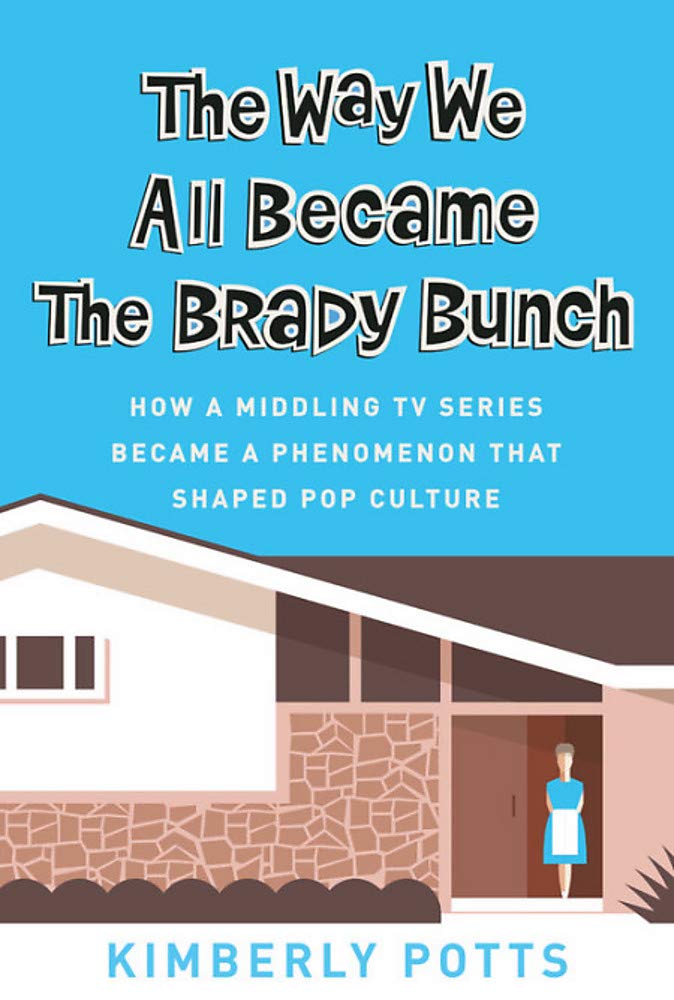
            I recently finished this book.


            When I was a kid, I was Brady Bunch obsessed. I watched the show in reruns continuously. I wanted toys with the Brady’s on them. I drew the Brady kids from my imagination. Wished I was a neighbor who could come over and throw the ball around with Greg, Peter and Bobby in that Astroturf backyard. I say it’s Alyssa Milano, but my first crush was probably on Maureen McCormick. And then Eve Plumb. But my story isn’t rare. My generation probably did more than any after it to solidify the Brady’s place in pop culture lore.

            But that was when I was a kid.

            When I finished that Brady Bunch book as an adult, it was like I’d recaptured some kind of joy. I found myself wanting more. So, I began watching whatever videos I could with the cast on YouTube. Interviews. Specials. There’s even an HGTV show staring the cast in which they remodel the inside of the Brady house to match the one we’d been seeing from the exterior our whole lives.  I found more books. Memoirs. I sat through entire episodes of the Brady Bunch Variety Show. I’m currently making my way through a podcast called The Real Brady Bros, hosted by Barry Williams and Christopher Knight. Greg and Peter Brady respectfully.

            And I’m making my way through all five seasons of the television show.

            Quite probably for the umpteenth time.

            And I’m loving it.

            I’m currently eyeing up this DVD boxed set.

            I recently finished this book as well.


            If there was a character who equaled my obsession as a kid as much as the Brady Bunch world, Muppet and Star Wars world did, it was Batman. I collected the comics, his and ONLY his. I watched the cartoons. I watched reruns of the ’66 TV show.

I wore the Underoos, man!

I dressed like Batman for Halloween. I acted like Batman on the playground at recess. I made those POW! and BAM! sound effects when we pretend fought (and sometimes really fought) in my neighborhood. With the exception of this year’s The Batman (thanks Covid), since 1989 I’ve seen every single Batman movie (yes, that includes 1997’s Batman & Robin) in the movie theater.

            When I finished that great book, the first thing I did was queue up that new Batman movie. Then I caught up on some of the animated films that have come out in recent years. And there are A LOT. I got myself back into Batman comics. I’ve since been through the Bane Wars and the Joker War. I’ve read about Gotham city putting masked crusaders on notice, by a new mayor who has a bone to pick. Now I’m getting ready to enter the Fear State, through the wonderful comics written by James Tynion IV.

            And I’m currently loitering in toy and comic book stores looking for the perfect 1996-era Batman & Robin action figures to put on my already cluttered writing desk, with all of these items.

            Books fuel my obsessions.

            They always have.

            When I went to Dublin it was Leopold Bloom I went searching for.

            I just finished this book.

            Guess what I’m watching too much of?

            At some point this week I’m picking up the first volume of these.

            It’s gonna be a Ring-A-Ding summer in my house!

            Books have also fueled my sports card collecting.

            One of them actually helped get me back into The Hobby.

            Back in October 2002 I wrote THIS article about my return to collecting in 2019. I got it mostly right. I discussed my anxiety. My nostalgia for collecting. The way I felt collecting cards as a kid, and how much different The Hobby was to me as an adult. I mentioned watching collectors open product on YouTube. I gave shout-outs to the blogs I was reading and the podcasts I was listening to. I wrote about how returning to collecting helped quell the anxiety.

But I left out one thing.

And what I left out of the essay was a book.

            Specifically, this book.


            If my memory serves me correctly, and it usually does, I read Josh Wilker’s Cardboard Gods during the summer of 2019, when my anxiety was at its worst. What I found in Josh’s book, despite its sometimes-tumultuous subject manner, was a calm. Not only a nostalgia for card collecting, but I genuine love. I felt at peace in his prose. I wanted to feel the peace. And I began thinking about my own childhood relationship to The Hobby, probably more with his book in my hands than I did watching Jabs or someone open up a wax box of 1987 Topps. I didn’t know it then, but I wanted to express how I felt about card collecting the way Josh did.

            Eventually I’d write something.

            But in the immediate, I wanted to collect again.

            Wilker’s book helped fuel the obsession. It was broad in scope. It, along with the other aforementioned blogs, etc., got me back into buying wax. Building sets. Starting up a PC again for the first time since 1992. The effects on my anxiety were slow at first. But they were tangible. Yes, there was worry during the day. But some of it was abated when I was able to come home and mess with cards, or spend my weekend morning collating sets, instead of waiting for my wife to wake-up so that I could complain about my job and act like the most woebegone man on the planet.

            But Wilker’s book was just a start.

            Not all of my collecting happens this way. The obvious way it through team affiliation and player performance. But I’m beginning to see that if I read a book about a specific athlete or team, I tend to dip my toe (or sometimes dive right into the deep end of the pool), into the card collecting aspect.

            Obsession.

            And it’s been a recent facet

            In the spring of 2021, my wife and I were vaccinated and finally able to go to Buffalo and Pittsburgh to visit family for the (mostly) first time since 2019. We were able to see our families, go out to eat and generally act like normal human beings. On a trip to a ½ priced books in the Pittsburgh suburbs. I came across this book.


            But I stupidly didn’t buy it.

            Instead, when I got back home to Brooklyn, I checked it out of my library. I was a baby to a five-year-old kid when the Pittsburgh Steelers were winning those Super Bowls and forging a dynasty whose legend looms large over city and team to this day. Those Steelers were already superheroes. Already talked about the echoes of gods walking amongst us. Never mind that by the time I old enough to watch The Steelers, it was when the winning stopped, the Super Bowls dried up, and those gods become mortals on the football field.

            Their legend was already locked up.

            I never thought I was going to return to football card collecting when I got back into cards. I’ve always liked football. But baseball is a way of life. A religion. I didn’t think football cards held a place for me. But getting back into them; it was an inevitability after I finished reading Their Life’s Work. If I wasn’t going to collect football cards generally, then I was at least going to have my fill of Steelers cards. And when I returned to Pittsburgh in July of 2021, I hit up the flea markets and did just that.


            I’m even buying the new guys now.

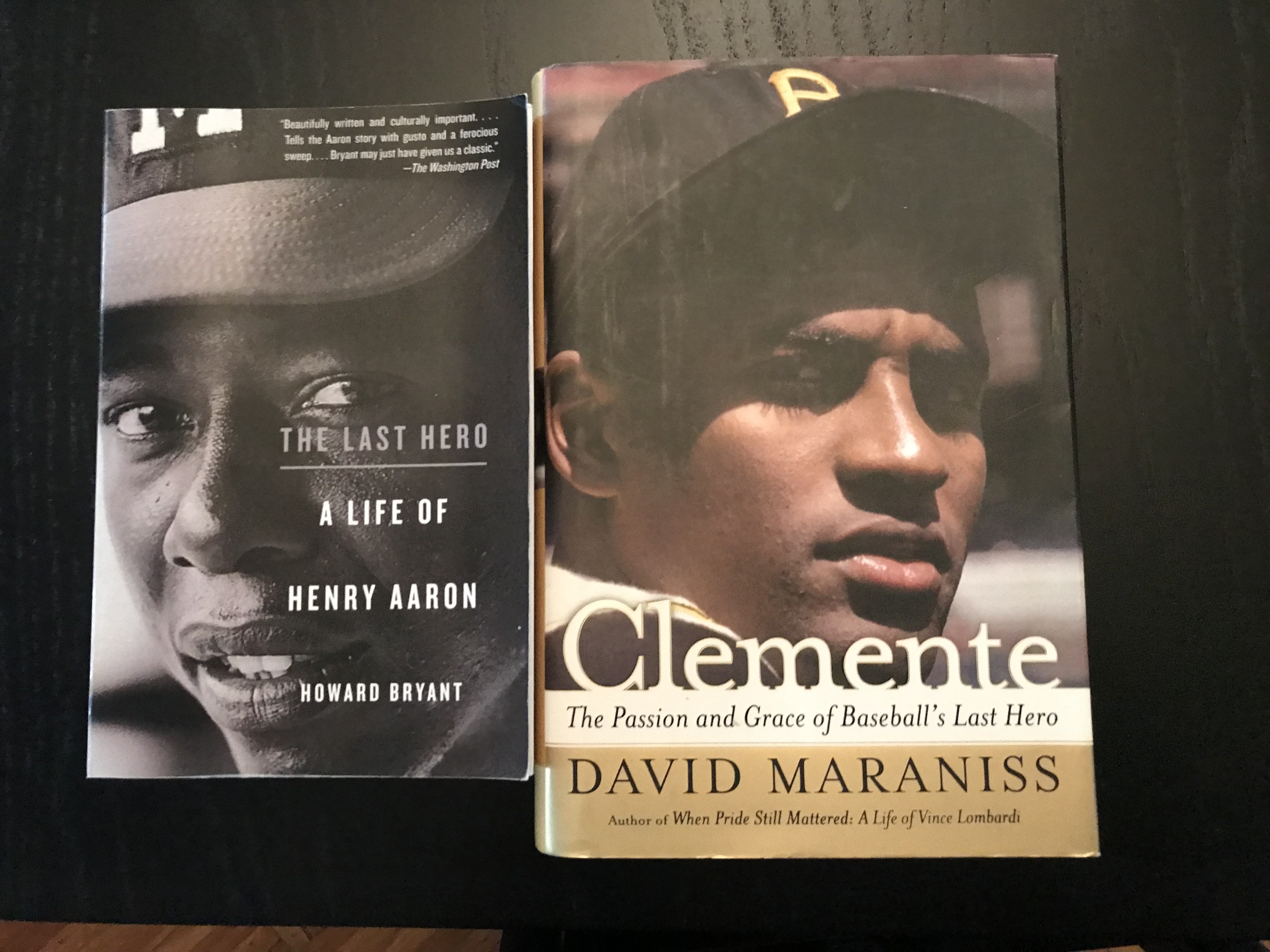
            I was a Dave Parker collector before I read this book.


            But, as with Their Life’s Work, reading Cobra got me to want to focus my collecting not on ripping all of that wax and building sets at random, but to focus more on the Pittsburgh Pirates cards I wanted. To connect my collecting to team history and lore.

            And it let’s you drop the dough on a cool card like this.


            It’s not just local teams.

            This book to collection ratio has been happening across the spectrum.

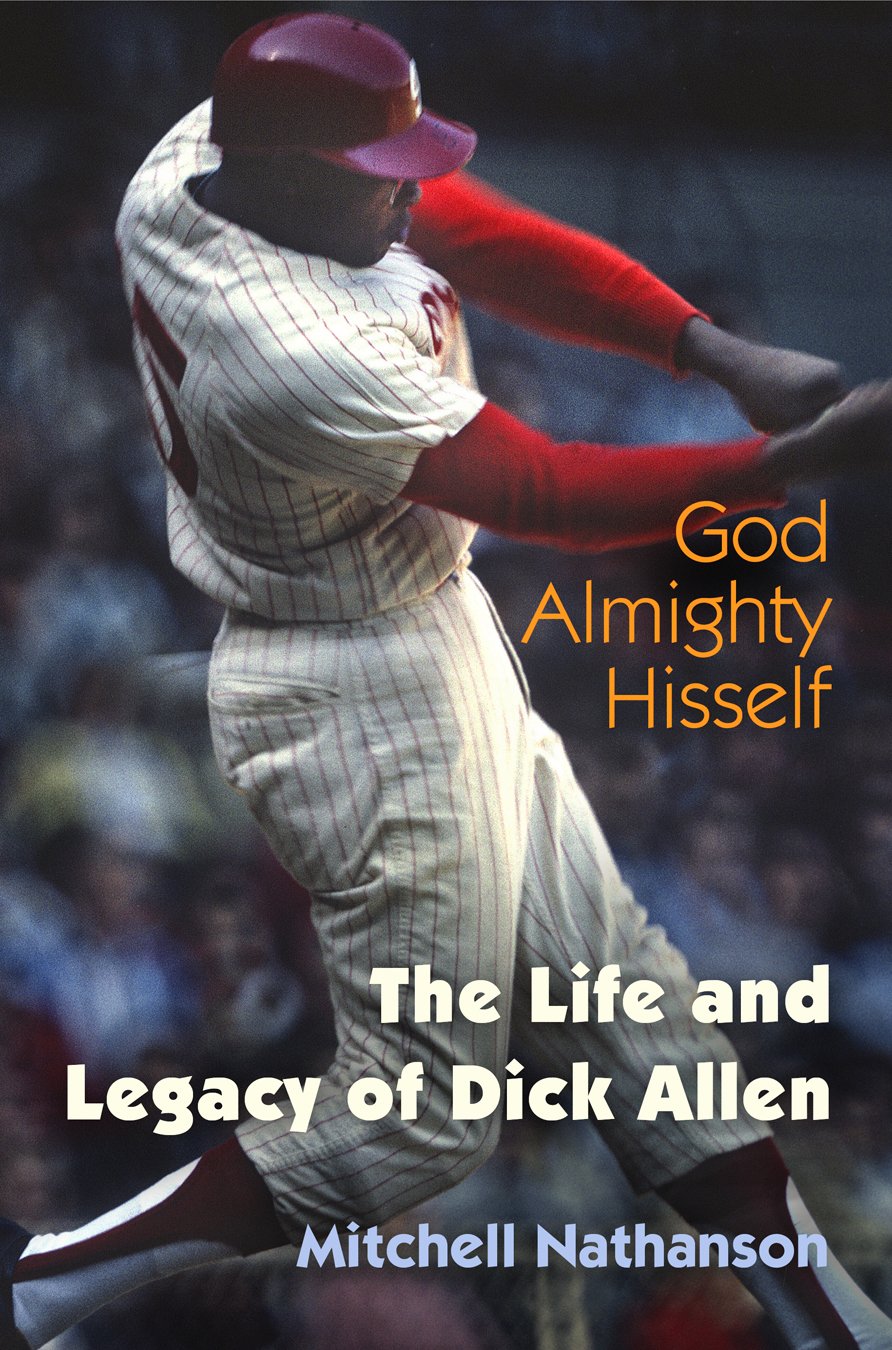
            I read this book on Dick Allen


…and this happened.  

I’m currently reading Dan Good’s wonderful book on Ken Caminiti.


…and yesterday I spent an hour or so going through boxes just to dig up these.


Next up is this one.


Rickey played so long, if I collect him, it’ll be like going down a rabbit hole in Alice’s Garden.

(And, no, I do not have his rookie…someone is gonna get my money on that one)

This book made me reconsider 1986 Topps, and is just a damned fine read.


If the guys in this book were playing now, they’d for sure, have a Topps rookie card. Probably in multiple products.

But for most of these guys its minor league sets or nothing at all.

Obviously, there are some books on players for whom you can’t just run out and fulfil your obsession buying cards.


But you can try.


And in some instances, reading a bio on a player just works to keep that long burning fire going.


What’s happening with all of this type of reading, or it least what I’m garnering from the experience, is that I’m developing a sort of subset to my collecting. Or what I call, Collecting by the Book. And I actually look forward to it. To seeing what books will show on my radar. How it’ll enhance and inform what I collect. I’m hoping a few more books that’ll get me digging into those boxes, like I did when I went searching for Caminiti. I don’t know what I’ll find. Or where they’ll go. Maybe in the same special place I reserve for cards that mean something to me. Maybe I’ll start a Collecting by the Book binder.

Right now, I’m in the hey-I’m-just-noticing-this-about-myself stage in this part of my Hobby journey.

So...stay tuned

Thanks for Reading! Happy Collecting!

NEXT FRIDAY: Russell Streur returns! 


Card Show Observations