Friday, June 10, 2022

Rookies, Rookies, Everywhere...and Not a Drop to Drink


I’m wondering if it’s all our fault.

            I don’t blame Generation X for much. I don’t want to go into cultural stereotypes or touchstones here about this generation vs. that. There are plenty of other, way better, sources out there closely examining the cultural zeitgeist. But it is safe to say that Generation X has kind of taken, maybe sort of is fostering, a backseat, laissez faire attitude toward the culture at hand. While the Boomers try to hold onto their last grasps of power, and Millennials and Generation Z try to take it away from them; Generation X seems content to kick back (yes, I’m obviously generalizing here), and let it all play out as it may.

            Besides…we’ve already done our damage.

            For proof, I gave you exhibit A.


            And exhibit B.


            (no…I don’t own a 1984 Donruss Mattingly card)

            Generation X might not be up to much politically or culturally these days, but if I try to pinpoint the generation who pushed The Hobby full force into Rookie Card Mania, I don’t need to look much further than us folks born between the years 1965-1980. We’re the ones responsible. We’re the reason The Hobby has been this way for almost forty years now. We’ve caused the bother. We’ve caused the pandemonium exhibited with every card release. We’re the reason you fly by every other card in a pack, looking for some twenty-one-year-old kid who batter .215 last season, but has tons of potential.

            I offer you exhibit C.


            (no...I don't own that one either)

            When I was twelve-year-old that Canseco card sold for $25 or more at card shows, when you could still pull it out of a pack. I didn’t know much about Jose Canseco in 1986, but you can bet I knew a ton about that card and coveted it as much as every other kid I knew who collected. We wanted the Canseco card. We wished there was a Wally Joyner card. We wanted Bo before Bo knew anything about anything, and that included hitting the ball for better than a .207 batting average. The ’86 Donruss Canseco was indicative of what The Hobby was becoming in 1986, what those ’84 Mattingly cards had popped off two years before. And its indicative of what The Hobby still is today.

Rookie-mania.

I offer you exhibit D from the crazy heyday of the Junk Wax Era.


All going to be worth a ton.

None of them worth much raw.

Not a Hall of Famer amongst them.

And even though their careers are said and done, I still get a twinge of excitement whenever I see their cards, or open their cards if I chance upon a pack of Topps from 1987.

I’m conditioned to.

Is it unfair to blame Generation X for the prominence of rookie cards in The Hobby? Yes...and no. Adult forces controlled The Hobby when I was a kid. Adults ran the major card companies. I bought cards from adults at my drug store, LCSs, and card shows. If you want to get technical, me and my ilk were hapless, helpless consumers at the mercy of the capitalist marketplace.

But…

We were the ones collecting the cards. We were the ones placing value on young players based on their performance, and the promise of their performance. We were the ones flying by late career cards of Mike Schmidt, Tom Seaver and Steve Carlton, hoping that Pete Incaviglia card was somewhere at the back of the pack...and not ruined by a gum or wax stain. We were the ones putting Corey Snyder cards in penny sleeves and top loaders having never seen him take a swing at the plate.

But…

Generation X was the first generation to experience the sports card Hobby truly explode. To you folks who began collecting in the 1960s, 1970s, and earlier…I know, I know; I’m extrapolating a lot here. I know you had your cards. I know you probably coveted a rookie here and there. I know you met with other collectors, traded with other collectors, and maybe even attended a card show here and there. And I’m not discounting that. But there’s a vast difference between how collecting was presented in the 1970s and the mania I witnessed during my youth.

It's weird to put it into words now, because of how prevalent the rookie card is in The Hobby. The excitement was palpable back then. The anticipation of the hunt was real. Wanting cards for players, and this is the 1980s here, that you most likely were never going to see play live OR on TV. And that (minus the access to games) has continued for forty years.

And we didn’t even have parallel and short print cards.

But we had a 1985 Doc.
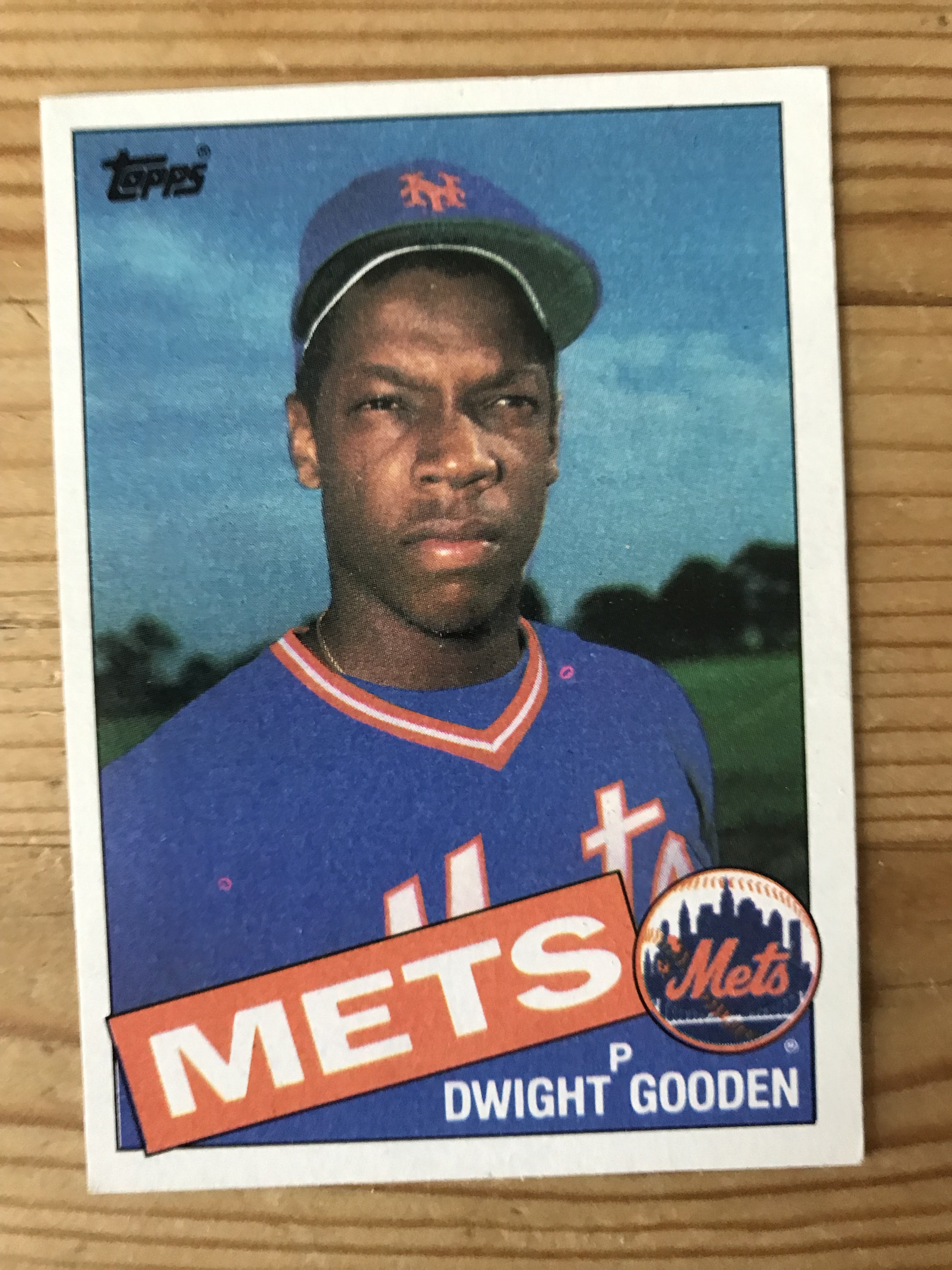

If you don’t believe me, take a look at the big letdown amongst many card collectors when Topps released the checklist for 2022’s series 2. No Witt Jr? No J-Rod? No Torkleson? Fuck YOU Topps! 

****Yes, I know Topps put SPs of Torkleson, Rodriguez and Witt J in series two....and if Blogger had an eyeroll emoji I'd use it....I don't like SPs...that said, to be COMPLETELY hypocritical, I'm opening a Hobby Box of Series 2 and if I pull one of those SPs, I'd gladly trade it to someone who has a 2022 Heritage SP of Oneil Cruz.****

There are YouTube videos literally railing against the release, and some calling it the worst ever. I’m not yet willing to say that about a set that’s going to have some Pirates I’m excited for, and Yordan Alvarez’s base card in it.

But it’s his third-year card…so what do I know?

Look, I like rookie cards. I keep rookie cards.


See?

I even collect rookie cards


Nothing can separate me from me and my Vlady rookies.


But you know what? I prefer his 2020 card more.


I think it’s neat-o that Topps places an emphasis on rookie cards. I find it humorous that the RC logo gets us all wild to the point where we even argue about its placement on said card. I still like the promise inherent in rookie cards, even though I’m well-versed in the burn. And, boy, can you get burned more these days than you ever could when I was a kid. Yeah, some dope might’ve shelled out $50 for that ’86 Canseco. But what about the collector who shelled out $150 for the Evan White auto card from last year?

What about that poor schmuck?

It just surprises me, at times, that the rookie card still takes up so much space in The Hobby. Especially with all of the other bells and whistles attached. You might not be getting a J-Rod or Witt Jr. rookie card in Series 2…but you can still hunt for their autos. Maybe, as a collector, I should be excited that people are still so passionate about base cards. Even if they are rookie base cards. It gives me hope as a collector that people still care about base cards.

Or…

It's about the parallel cards…isn’t it?

The…goddamned…parallel cards.

I meant what I said about being excited for Yordan’s base card in Series 2. Manny Machado is in Series 2. So are Ozzie Albies, Cody Bellinger and Bryan Reynolds. Just to name a few. That’s some exciting young talent. More so if the real Cody Bellinger ever shows up again. As a Pirates fan, the Rookie Cards in Series 2 are actually pretty sweet: Oneil Cruz and Roansy Contreras look like cornerstones of the franchise in the years to come. There’s even a Pirates rookie card for some player named Connor Overton…whom I don’t even remember.

Maybe because he pitched all of 8 innings for the Pirates last year...and doesn't even play for them anymore.

And that’s a point of contention that I do have with rookie cards. There are 57 rookie cards in Series 2. That’s 57 cards out of 330 cards. Add that to all of the stupid team cards and combo cards Topps adds, and that a pretty big chunk of your base product right there. Yeah, rookie cards are cool, but if a rookie card ends up taking the place of a player who maybe more deservedly should have a base card, than some twenty-year-old prospect who played in two games; well…that’s where I’m decidedly not for the rookie card.

That’s where I draw the line on the big RC.

And for the record...those Oneil Cruz and Roansy Contreras rookie cards I'm looking forward to? They only played in a couple of games last year as well.

***That said, I would gladly trade someone the Nolan Ryan or Mookie Betts seen here for the 2022 Heritage SP of Oneil Cruz***


If Generation X caused this focus in The Hobby…then I’m truly sorry. I kid, I kid. I don’t really blame Generation X for the state of The Hobby. The lack of involvement in politics? Sure…I blame Generation X. As for The Hobby…it’s all fun. Enjoy the rookie cards, I say. But don’t forget about all of the cool base cards for star players, or team players that you root for in any released set. Those are the cards that are going to mean more going forward. They’re the ones that hold the memories for me, and the ones that are making the new memories.

I might not be getting a Julio Rodriguez in Series 2 (enough with the J-Rod shit).

But I’m getting my first Michael Chavis card in a Pirates uniform.


And that’s pretty cool.

Now…excuse me while I go on ComC and get me that that ’84 Donruss Mattingly I always wanted.


Thanks for reading! Happy Collecting!


NEXT FRIDAY: We do the inevitable…we talk 2022 Topps Series 2.


Friday, June 3, 2022

Searching for Meaning in a World that Doesn't Make Sense or....2022 Bowman Baseball Cards


When you’re a fan of a small market baseball team

            Sigh…yes…we’re talking about that again.

            When you’re a fan of a small market baseball team, you talk a lot about rebuilding. About youth movements. The windows of opportunity are…well…small. You probably pay more attention to the minor league teams than people in larger markets probably do. You’re always looking for some prospect to break out. To become the savior. The hero. The next legend…for as long as you get legends in small markets.

When you’re a fan of a small market baseball team you hope more.

You wish more.

            You speculate.

            As a fan of the Pittsburgh Pirates Baseball Club; I’ve been doing a bit more speculating with my collecting choices over the last few years than I have been collecting players with full assurance of their talent and value to the team the future. That’s not to say I’ve gone the full prospect route. No. But I’m probably investing more in my Pirates baseball cards than the actual owners and his organization guys are actually investing in the team. At least right now.

            But I am hedging my collecting bets more on the future than I ever did in the past.

            And a good place to do that is with Bowman.

            No, I’m not breaking my promise to myself and adding another set to collect into the mess of unfinished sets that I have on my shelf. And I’m not chasing every prospect out there looking to strike gold. But for the last year I have been buying Pittsburgh Pirates cards in Bowman. I started with collecting last year’s Bowman Pirates cards. Then I put the 2021 Bowman Prospects team together. And just a few weeks ago, these babies arrived for me.


            It’s almost the complete team.

            A prospect by the name of Maikol Escotto has yet to arrive.

            I’m not speculating. Not with the idea that I’m going to be making any money off of these cards. That’s never been what collecting has been about for me. To be honest, the prospects appearing on Bowman products are, well, more exciting than the players appearing of the big-league club’s team sets.

            With exceptions to these guys…of course.


            The players appearing on Bowman products come with…promise.

            This guy is already on the big-league club.


            This guy should already be on the big-league club...thanks Service Time manipulation!


            And these guys don’t feel too far behind.


            And, boy, could the Pirates use this guy behind the plate right now.


            But…patience…patience.

            Remember what I said about hope and small market teams?

            I shouldn’t be by now, but I’m always so surprised at how prospect-heavy the Bowman release is every year. You have to understand that I was right in my wheelhouse of collecting when Bowman came back in 1989. There were prospects, yes, but the checklist still catered heavily to the big-league clubs.

            Although this guy was in the set.


When rookies and prospects became more of Bowman’s bag (I’m going to say 1992 and beyond) I was done or almost done with collecting. When I got back into collecting in 2019, I didn’t even mess with Bowman. I kind of considered it a glorified minor-league set.

            But then somewhere in the middle of a 101-loss season last year.

            And necessity being the mother of invention.

            I began to view Bowman products a bit…differently.

            Ok...I just wanted the cards of players I could be excited for.

            Is that so wrong?

            And Bowman gives you the players to be excited for. The Pirates have four base cards in this year’s set, and three of them have the RC logo on them.

           So, what you get is a team set of excitement. Or potential excitement. The potential of excitement. How does that sound? And what’s more exciting than rookie potential? Am I being sarcastic here? I kid. I like rookie cards as much as an collector. Although Bowman could’ve put Bryan Reynolds in the set. I mean he did start in last year’s All-Star Game. I guess I can’t complain…they didn’t give Tim Anderson a card either.

            Excitement for prospects has to go a long way with Bowman because…well…the cards aren’t very interesting looking. There’s usually a bland border that seems interchangeable from each release. Topps does the basic work of putting the players name and position on the card; the team they play for.             The backs are also interchangeable from year to year. 


            I’m not going to lie, but I’ve spent more time looking at the copyright on the back of Bowman cards to determine what year the product was released in than I ever have with Topps base product.

            But there’s just something about the 1st Bowman logo on a card.

            Especially for a player you hope to see in the big-leagues one day.

            As a returning collector (I’ve been back for 3 years now but I’m still going to call myself that) I do like what Bowman has become. A home for prospect cards. In 1989, it was such a weird anomaly in collecting. An over-sized throwback set that didn’t fit in sleeves or sheets is what 1989 Bowman was. The first “heritage” set of its kind. Us kid collectors were either turned-on or off by it

I was the former.

I loved 1989 Bowman baseball cards. Am a big fan of the minimalist approach they took in 1990 and 1991 too. Maybe that makes me a hypocrite in terms of my criticisms of current Bowman designs. But I felt like old Bowman was looking back, or, in their initial years (1989-1991) were trying to make a card that looked retro. I’m not sure what the modus operandi of Bowman designs is now. I’m not sure they have one other than to get cards of prospects out in the world on a design that doesn’t totally offend people aesthetic sensibilities.

If that’s the case Topps succeeds…mostly.

I just know that I’ve begun to find some enjoyment in the product.

It’s kind of fun, seeing a player on their 1st Bowman card.


And then a few years later…this.


Thanks for reading! Happy Collecting!

NEXT FRIDAY: Rookie cards, rookie cards...everywhere rookie cards...I'm tired of rookie cards...so why does the Topps Series 2 checklist bum me out so much?


Thursday, May 26, 2022

COLLECTING MILWAUKEE: 70 YEARS OF TOPPS MILWAUKEE BASEBALL CARDS By Russell Streur


COLLECTING MILWAUKEE:  70 YEARS OF TOPPS MILWAUKEE BASEBALL CARDS  


By common practice, baseball is passed on from father to son.  Not so in my case.  My mother’s marriage busted up when I was at a young age and in the absence of any other alternative in the mid-1950s, mom moved out of a Chicago apartment with me and Nean, the best older sister in the history of the world,  back to live with her parents, our grandparents, in a country house on Pine Lake in Waukesha County, Wisconsin.  And so I learned baseball not from a father, but from my grandmother, Esther Risley.  Grandma Esther knew everything.  She drove powerboats, sailed and rowed, played a mean hand of contract bridge and could pour a cocktail with either hand.  She knew the songs of all birds in the neighborhood, the names and growing habits of all the plants in the neighborhood, and everything about baseball a five-year old boy could want to know.  Especially, back then, everything about the Milwaukee Braves.


Every day, we would listen to the Braves on a Zenith 500 Royal transistor radio, maroon in color, with a gold mesh screen over the speaker, tuned to the team’s flagship station, WTMJ 620 on the AM dial, Earl Gillespie and Blaine Walsh calling the action.  Sundays were the best days, with double-headers on the schedule, and Mondays the worst, being travel days in an era when clubs rode the rails from series to series and city to city.


If the Braves were rained out, we would tune in the Chicago Cubs.


Every so often, Grandpa Russ and Grandma Esther would bundle me and Nean off to see the Braves play in Milwaukee at County Stadium, taking the train from the Oconomowoc station to the Milwaukee Depot on the morning Hiawatha.  On real special days, Grandpa would find us seats in the Dome car.  Going to a game in that kind of style was enough to faint half-dead away from the pure excitement of it all.  Even today, a lifetime later, going to a game is the better joy of the day.  Being at the game comes in second.


The Hiawatha, Postcard, 1956


The Braves finished a game behind the Brooklyn Dodgers in 1956 but grabbed the National League pennant the following year, capping the season with a World Series win over the New York Yankees.  Lou Burdette powered the Braves in the seven-game set, winning three games.  The Yankees won a rematch in 1958.  In 1959, the Braves lost a three game playoff series for the National League pennant to the relocated Los Angeles Dodgers.


I could follow standings, but I knew nothing about baseball cards until 1961, when Mom remarried and the family moved to a quiet suburb of Milwaukee.  And there on an elm-lined Idlewild Avenue, I learned the collecting business from the cool kid down the block, Danny Rumelt.


Topps 1953.  Left:  Bill Bruton, Card 214.  Right, Del Crandall, Card 197.


Topps considered the move of the Braves from Boston to Milwaukee one of the biggest sports stories of all time.


Braves Go to Milwaukee, Topps Scoops 1954, Card 130


My favorite Braves issue was the 1959 design.


Topps 1959.  Clockwise from upper left, Hand Aaron, Card 380; Lou Burdette, Card 440;

Warren Spahn, Card 40; Ed Mathews, Card 450.


And there were favorite cards from other years, too.


Top: Juan Pizarro, Topps 1960, Card 59.  Bottom: Braves’ Fence Busters, Topps 1958, Card 351.


Left: Frank Bolling, Topps 1964, Card 115.  Right: Rico Carty, Topps 1965, Card 305.


Now of course, I only touch the cards through protective plastic sheets and sleeves.  I miss the feel of that old cardboard.


After the Braves defected South for the 1966 season, there wasn’t any reason to keep collecting. 


Atlanta Braves, Topps 1966, Card 326.


In 1967, car dealership owner and former Braves minority stakeholder Bud Selig arranged an exhibition game in Milwaukee between the Minnesota Twins and the Chicago White Sox.  Played on Monday night, July 24, the event drew a record 51,144 fans through the turnstiles at County Stadium, far above the stadium’s official capacity of 43,678.


Minnesota Twins, Topps 1967, Card 211.


By then, the attention of the boys on the block had already turned away from baseball to girls, the Vietnam War, and marijuana, not necessarily in that order.  But Bud Selig had all the proof he needed to believe he could bring the game back to Milwaukee.


Bud Selig, Topps 2019, 150 Years of Baseball, Card 150-54.


The Milwaukee White Sox


And so the Chicago White Sox became—at least for a few nights in 1968 and 1969—the Milwaukee White Sox.  How Selig lured every American League team to give up a precious off-day to come to Milwaukee to play the nomadic Sox isn’t easy to figure, but it happened.  County Stadium hosted nine games in 1968 as the part-time home of the Pale Hose; the White Sox lost all except one, a 2 to 1 victory over the Cleveland Indians in June 17.  The results on the field counted less to the Chicago brass than the fans streaming through the gates—the few dates in Milwaukee accounted for almost a third of the total White Sox attendance for the year.  


Eddie Matthews had something to do about those numbers.  The legendary Milwaukee third baseman, then nearing the end of his playing career as a veteran presence on the Detroit bench, was honored in a pre-game ceremony when the Tigers faced the Sox on August 26.  42,808 fans paid respects to the slugger.  Not yet fully recovered from surgery for a ruptured disk, Matthews suited up but did not play in the game. 


For the Sox, the lure of big crowds and much-needed paydays guaranteed an encore season in Milwaukee.  They played better, winning five straight games to open the Milwaukee share of the season, their fifth win coming on June 16 against the Seattle Pilots, making their first—but as it turned out, not their last—trip to Milwaukee. 


Average attendance at the games dipped slightly from 1968, but the Wisconsin turnstile count represented an even larger percentage of the season gate for the Windy City team than the previous year.


It’s said that Selig had a handshake deal to move the White Sox to Milwaukee on a full-time basis for 1970, but the American League vetoed the sale, unwilling to abandon its Chicago turf to the National League Cubs.


Clockwise from upper left: Walt Williams, Topps 1968, Card 172; Luis Aparicio Topps 1968, Card 310; Sandy Alomar, Topps 1969, Card 283; Tommy John, Topps 1969, Card 465.


The Pilots Crash and Baseball Comes Home to Milwaukee  


Selig got the break he needed when the underfinanced 1969 Seattle Pilots went broke after their first and only year in outdated Seals Stadium.  Selig grabbed the team off the auction block and moved the club to Milwaukee a few days before the start of the 1970 season.  From 1971 to the present day, Topps has issued Milwaukee Brewers baseball cards—1,425 regular season, traded, update cards (plus 2022 season) more or less.  With the help of a few ringers thrown in here and there, the cards tell the history of the Brewers franchise.


Last to First. Left: The last Seattle Pilot baseball card, Gus Gil, Topps 1970, Number 651.  Right: The first Milwaukee Brewer baseball card, Phil Roof, Topps 1971, Number 22.


It took a while for the new team to gain a following.  Game attendance dropped sharply from 1970 to 1971 to barely half the league average.  The strike-shortened 1972 season was worse.  Hank Aaron’s return to Milwaukee provided a much-needed boost in 1975, but the team didn’t really catch on with the fans until the end of the decade.


The Last Hanks


Left:  Hank Aaron, Topps 1975, Card 660.  Right:  Hank Aaron, Topps 1976, Card 550.


Hank Aaron returned to the Brewers from the Atlanta Braves to finish his major league playing career where it began, in Milwaukee County Stadium, for the 1975 and 1976 seasons.


The Money Infield


Clockwise from upper left:  Robin Yount, Topps 1975, Card 223; Jim Gantner, Topps 197,9 Card 154; Don Money, Topps 1975, Card 175; Paul Molitor, Topps 1979, Card 24.


It took a while for the Brewers to figure out where to play everybody left of first, but eventually things settled down to Molitor at third, Yount at short, and Gantner at second.  The trio set a major league record by playing together for 15 consecutive seasons from 1978 through 1992.  The record held until the Yankees' Mariano Rivera, Derek Jeter, and Jorge Posada reached 16 seasons in 2010.

 
The Bombers and the Wallbangers


Clockwise from upper left:

Harvey Kuenn, Topps 1983, Card 726; George Bamberger, Topps 1987, Card 468;

Larry Hisle, Topps 1979, Card 430; Cecil Cooper, Topps 1980, Card 95.


Clockwise from upper left:

Gorman Thomas, Topps 1981, Card 135; Ben Oglivie, Topps 1979, Card 519;

Rollie Fingers, Topps 1982, Card 586; Pete Vuckovich, Topps 1982, Card 643.


Bambi‘s Bombers and Harvey’s Wallbangers tattooed American League ballparks with hundreds of homeruns between 1978 and 1982, many by the four sluggers pictured above. Pitching wasn’t bad either. Pete Vuckovich recorded 32 wins against only 10 losses in 1981 and 1982 and Rollie Fingers rang up 57 saves during the two campaigns. But it wasn’t enough to take home the flag in the Brewers first and thus far only World Series appearance. The Brew Crew fell in seven games to the St. Louis Cardinals in 1982.


The Return to the National League


The Brewers returned to the National League in 1998. In equal parts promptness and irony, the team lost the season opener on the road to: the Atlanta Braves. A few days later, the Brewers reversed direction, defeating the Montreal Expos in their home opener. Jeromy Burnitz blasted his fourth home run of the young season, a three-run shot in the fifth, to power the win. Burnitz would finish the season with 38 homers for the club and 125 RBIs, but it was strictly a one-man show. Jose Valentin was second on the team in homers, far behind at 16 homers and with just 49 RBIs to show for the swings. The best the club could do on the mound was Bob Wickman, who earned 25 saves in the late innings, and a pair of ten-game winners in starters Scott Karl and Steve Woodard, each of whom finished the season with losing records. The Brewers finished last in their division. 


Clockwise from upper left: Bob Wickman, Topps 1999, Card 151; Jose Valentine, Topps 1998, Card 158;

Scott Karl, Topps 1997, Card 58; Jeromy Burnitz, Topps 1998, Card 126.


The Prince of Diamonds


Top to Bottom:

Thunder on the basepaths. Fielder runs down Albert Pujols off first base, Topps 2008, Card 536;

All Star MVP, Topps 2011, Card US21. Fielder bowls over his teammates, Topps 2010, Card 1.


Prince Fielder was one of the biggest—as in big—favorites with Milwaukee fans of all time during his seven seasons with the Brewers. The 275-or-thereabouts-pound giant led the National League with 50 homers in 2007 and the major leagues two years later with a whopping 141 RBIs. He won the State Farm Home Run Derby in 2009 and was selected as the All-Star MVP in 2011, the first Brewer to win the honor in the history of the franchise.

Topps Heritage.  The modern, glossy action photographs on baseball cards create an immediacy and an excitement that earlier cards certainly lacked.  But sometimes, a portrait or a pose give an insight to the player’s personality that the action shots can’t capture.  Heritage cards bring continuity to a Topps collection, building a bridge between the present and the past. 


Topps Heritage (2020), duplicating the design of the original 1971 Brewers set.  Clockwise from upper left:   Lorenzo Cain, Card 435; Brandon Woodruff, Card 374; Eric Thames, Card 397; Orlando Arcia, Card 34.


Orlando Arcia was my favorite Brewer of recent years because of his enthusiasm, team commitment and clutch hitting.  He was traded in April 2021 to:  the Atlanta Braves.


Topps Heritage 2021.  Clockwise from upper left:   Adrian Houser, Card 583; Willy Adames, Card 662; Christian Yelich, Card 251; Luis Urias, Card 512.


 Topps 2022.  The 2022 set marks the 70th season of Topps covering Milwaukee baseball.  The cards have come a long way.  This year’s set looks pretty good.


Topps 2022.  Clockwise from upper left:   Omar Narvaez, Card 139; Freddie Peralta, Card 13;

Aaron Ashby, Card 78; Corbin Burnes, Card 240.


Topps Now.  In the past four seasons, Brewer pitching arms have lifted the club into post-season competition.  Devin Williams won the NL Rookie of the Year award in 2020; Josh Hader won NL Reliever of the Year for the third time in his young career in 2021; and Corbin Burnes won the Cy Young award in 2021.  That season, Burnes and Hader collaborated on a combined no-hitter.


Top Row.  Left to right: Topps Now 2021, Corbin Burnes, Card OS-39; 
Topps Now 2020, Devin Williams, Card OS-39; Topps Now 2021, Josh Hader, Card 0S-25.

Bottom:  Topps Now 2021, Burnes Hader No Hitter, Card 792.


But the bats haven’t kept pace, and the Brewers have been eliminated in each of the last four years without winning a league pennant.  In 2021, the Brewers were pushed aside by:  the Atlanta Braves.


Atlanta.  There’s that word again.  Somewhere in the world, a weary traveler is turning, turning slowly, step by step, inch by inch.

Card Show Observations