Collecting The Negro Leagues by Russell Streur

Topps Now, Card OS-52, 2021
.
John Jordan “Buck” O’Neil, Jr., tireless champion of Negro League Baseball, finally gets his due this week when he is inducted in the Baseball of Fame. O’Neill spent nearly all of his life in the game, joking that he became an overnight sensation at the age of 82 for his work with Ken Burns on the Baseball documentary series.
Born in 1911, O’Neill paid his dues in the Negro Leagues, breaking
in with the Memphis Red Sox of the Negro American League in 1937 before a
decade with the Kansas City Monarchs. A
three-time All Star at first base during his playing days, he then won four
Negro American League titles as the manager for Monarchs during the declining
years of Negro baseball.
Afterwards, he scouted for the Chicago Cubs, signing Lou
Brock to his first professional contract.
"He got me started on a journey that became a 19-year
major league baseball career," Brock said. "It's no wonder that baseball is
considered America's pastime. Buck was
one of its architects. He helped shape
the game.”
In 1962, O’Neil became the first black coach in the major
leagues with the Cubs. He mentored Ernie
Banks, Billy Williams and other young players during a 33-year career with the
North Siders. In 1988, he joined the
Kansas City Royals organization. In his
later life, O’Neil led the effort to establish the Negro Leagues Baseball
Museum in Kansas City, and he served as its honorary board chairman until his
death in 2006.
Some years ago, the good people at Cardboard Connection
posted a piece titled “7 Awesome Negro League Baseball Card Sets.” The un-bylined article works its way from the
Fleer Laughlin sets of the 1970s through the Ron Lewis set of 1991. A few subsets are included in the
survey.
https://www.cardboardconnection.com/guide-collecting-negro-league-baseball-cards
Here are some other sets to add to the list.
Remembering the Negro Leagues, Tuff Stuff Magazine,
September 1992
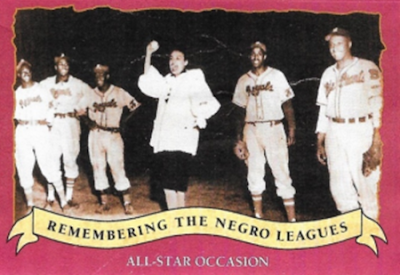
Tuff Stuff was a trading card magazine that was first published in 1984. It enjoyed a sometimes robust 25 years in print before surrendering to the digital page. Along the way, the magazine regularly featured card inserts. “Remembering the Negro Leagues” was the topic for a nine-card set in the September 1992 issue.
None of the cards in the set featured any single
player. Instead, the set invoked the bigger
landscape of the Negro Leagues—the busses and Pullman cars, the teams, the
stadiums and the East-West games.
Unlike the white major leagues, the World Series was never
the signature event of a Negro League season.
Instead, the East-West Game brought out the glitter and the fans. Gus Greenlee, owner of the Pittsburgh
Crawfords, and club secretary Roy Sparrow, are commonly given credit for
creating the late season showpiece.
Debuting just two months after the first white All-Star game
was played in 1933, the East West spectacle was an instant hit. Almost always played at Comiskey Park in
Chicago, the game became the most important event on America’s Black sports
calendar. The Union Pacific added extra
railroad cars to accommodate the fans flocking to the Windy City. In 1944, the East West game outdrew the white
All-Star game, and more than 50,000 fans attended the event in 1945.
“That was the glory part of our baseball,” said Sammy
Hughes, chosen in 1937 from the Washington Elite Giants as the second baseman
for the Eastern team. “It was an honor
to be picked even if you were just gonna sit on the bench.”
Exhibitions between black and white teams also drew big
crowds. Singer, actress and Civil Rights
activist Lena Horne is pictured on Card 8 of the Tuff Stuff set, throwing out
the first pitch in a 1945 game between nines from each side of the color
line.
1933 Negro All Stars, The Sporting New Publishing Co., 1988

Clockwise from upper left: Willie Wells, Oscar Charleston, James “Cool Papa” Bell, William “Judy” Johnson.
The title of this small collection suggests that it consists
of players from the inaugural 1933 East West game. The hint is partially true—seven of the
players on the unnumbered 12-card set were selected for the September 10
event.
First baseman Oscar Charleston of the Crawfords received the
most votes in 1933 with 43,793 ballots.
Pitcher Willie Foster of the American Giants followed with 40,637. Foster rewarded the fans with the only
complete game in the game’s history, an 11 to 7 win for the West. George “Mule” Suttles supplied the power for
the winning side with a home run, a double, two runs scored and three RBIs. Of the three stars of the game, nly
Charleston is included in the set.
Photography is attributed to Charles Martin Conlon, but the
set does not come anywhere the precision or the production quality of the
Conlon Collections of the white major leaguers issued in the early 1990s.
What Could Have Been, Inserts, Topps, 2001

The ten Topps What Could Have Been insert cards from 2001
cover many of the same players and does a better job of image selection and
production than the Sporting News set.
The Negro League Baseball Players Association Give-Aways,
1992

Clockwise from
upper left: Bill Wright Card 12, Edsall “Big” Walker Card 11
Martinez “Skippy”
Jackson Card 18, Sam “The Jet” Jethroe Card 10
Baseball runs deep in the anthracite veins of Lackawanna
County, Pennsylvania. Dozens of players
from the county played the big-league game, and two Hall of Famers are buried within
its borders: long-time Detroit Tigers
manager Hughie Jennings and American League umpire Nestor Chylak. Even with the heritage, it’s a remarkable
statement that the fan give-away at the minor league Scranton Wilkes-Barre Red
Barons game on August 9, 1992, was an 18-card set of Negro League players
produced by Eclipse Cards and sponsored by Kraft General Foods. Painted by artists Jon Bright and John Clapp,
the set includes well-known names like Leon Day, Double Duty Radcliffe, Buck
Leonard and Josh Gibson as well as less famous players.
Martinez Jackson played second base for the Newark Eagles in
the 1930s before opening a tailor shop in Philadelphia. Baseball ran deep in Jackson’s veins, too,
all the way to Cooperstown. He’s the
father of Reggie.

Sponsored by Eclipse
Enterprises and painted by Paul Lee, the four-card set pictured above was a fan
give-away at Shea Stadium on June 2, 1992.
https://www.ebay.com/itm/144279869489
Josh Gibson Inserts Topps 2007
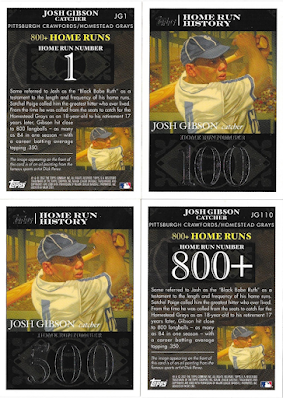
Granted, a 110-card set based on Josh Gibson’s home runs was never going to be an easy task. The lack of records for games played by Negro League teams makes it impossible to come anywhere near a true figure for Gibson’s total, much less a chronological progression. But even left with just a fraction of the whole, there are numbers that can be documented. Hank Aaron hit a home run every 16 at bats. Gibson hit one every 13 in official records. Gibson’s lifetime batting average of .374 is better than Ty Cobb’s mark of .366. A 12-time All Star, a four-time batting champion, and the universally acknowledged home run king of Black baseball.
And there’s testimony.
Hall of Famer Monte Irvin said "I played with Willie Mays and
against Hank Aaron. They were tremendous players but they were no Josh
Gibson." Hall of Famer Roy Campanella said Gibson was, "not only the
greatest catcher but the greatest ballplayer I ever saw." When Barry Bonds was asked about holding the
home run record, Bonds replied, “No, in my heart it belongs to Josh Gibson.”
That’s just on the field.
There’s also his life. The death
of his wife giving birth to twin children, his own health problems, and his
dejection over not being chosen to integrate the major leagues after World War
Two. “I think that’s one of the reasons
why Josh died so early,” said Larry Doby.
“He was heartbroken.”
But Topps gives us little of this—just the same picture on
all 110 cards and the same brief bio on the back. Only the numbers change. It’s a shame.
Front Row, 1992
In contrast, a pair of limited-run, five-cards sets issued
by Front Row in 1992 includes player statistics on one card and biographical
sketches on the other four. Each offers
an example of what Topps could have done with the Josh Gibson set, had Topps
been truly invested in the offering.


Negro Leagues Legends, 2020
If there’s one set of Negro League baseball cards to have,
this is the one. Commissioned to mark
the 100th anniversary of the founding of the Negro National League,
this 2020 issue of 184 cards is the most comprehensive set of Black baseball
cards published to date. Painted with
grace and a sure hand by baseball artist Graig Kreindler, the set includes all
the Negro League greats but really gains its worth by the wider net it
casts.
There’s a story worth knowing on every card.

Clockwise from upper left: Lazaro Salazar, Card 60; Perucho Cepeda, Card 27; Ramon Bragana, Card 114; Estaban Bellan, Card 156.
Players from the Mexican and Dominican Leagues and the Cuban
and Puerto Rican Winter Leagues are included too. Chief among the Latin players and managers
are Lazaro Salazar, who eaned batting titles in three countries, won 150 games
as a pitcher, and managed clubs all over Latin America to 14 league
championships; Pedro Anabal “Perucho”
Cepeda, patriarch of the major league Cepeda clan; and Ramon Bragana, elected
to both the Cuban and Mexican Baseball Halls of Fame. Though white, Estaban Bellan is included in
the set for his role in establishing the game in Cuba.
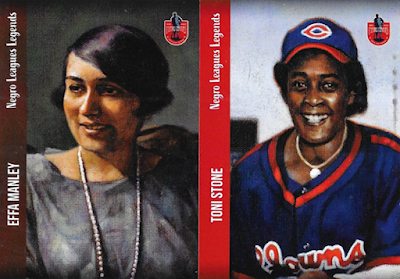
Left: Effa Manley, Card 148. Right:
Toni Stone, Card 167.

Left William
Lambert, Card 83. Right Unknown Player,
Card 128.
Organized baseball was segregated for decades, but military
teams did not always follow suit.
William Lambert, who pitched the integrated team of the USS Maine to the
Navy championship in December of 1897, died along with most of his teammates
when the battleship blew up in Havana harbor a month later.
The most poignant card in the set is the Unknown player,
symbolizing all the Negro League players whose names and stories have been lost
to time.

Minnie Minoso (Card 120, left) and Moses Fleetwood Walker (Card 110, right) also among this year’s inductees, are also included in this set. It’s a home run collection, a mighty Josh Gibson clout of a set. It will be hard to top, and definitely recommended for anyone interested in the history and players of the Negro Leagues.

Buck O’Neil. (Left) Negro Leagues Legends, 2020, Card 176;
(Right) Negro Leagues
Legends, 2020, Card 184.

Fleer, Greats of the
Game, 2001, Card 119
Play on, Buck.
PITTSBURGH PIRATES NEGRO LEAGUES STARS GIVEAWAY 1988
The Philadelphia Phillies played
the Pittsburgh Pirates in a game at Riverfront Stadium on September 10, 1988. Ron Jones homered for the visitors in the
Saturday night affair but defensive miscues by his teammates gave the Pirates
all the help they needed to overcome the swing.
Dave LaPoint pitched all nine innings and picked up his seventh straight
win and 14th of the year as the Pirates prevailed, 5 to 1.
1988 marked the 40th
anniversary of the last World Series played in the Negro Leagues, won by the
Homestead Grays over the Birmingham Black Barons, four games to one. By that time, the Grays were playing most of
their home games out of Griffith Stadium in Washington, D.C., but the team’s origins
were all Pittsburgh and the club still maintained deep ties to the Steel City.
Regardless of the Grays home
address at the time, Black baseball owned a rich tradition in Pittsburgh. The Grays themselves hailed from Pittsburgh’s
Homestead neighborhood. In the 1930s,
the Pittsburgh Crawfords emerged from the Hill district and powered their way to
three league pennants. The Pirates, in
partnership with the Duquesne Light Company, celebrated Negro League baseball that
late summer night at Riverfront, presenting a plaque honoring the Grays and
Barons to the city and giving away a set of baseball cards to the fans.
The set was one of the earliest
ever produced on Negro League players, preceded only by the two Fleer Laughlin
sets in the 1970s and the Fritsch collection of 1986.
For the first time, Negro League team pictures were shown on baseball cards, including rare images of early Grays and Crawfords clubs. The dates of the photographs only hint at the long history of Black baseball in Pittsburgh.

Left to right, front row: Ben Pace, Jerry Veney, Emmett Campbell. Middle row: Pete Peatros,
Eric Russell,
Cumberland Posey, Sel Hall, John W. Veney, Bob Hopson, Hubert Sanders.
Back Row: Henry Saunders, Sam Smith, B. F. Alexander,
Roy Horne, Ralph Blackburn.

Left to right, front
row: William Smith, Tootsie Deal, ?
Julius, Wyatt Turner, Reese Mosby, Bill Jones, Tennie Harris, Johnny Moore.
Back row:
Nate Harris, Bill Harris, Harry Beale, Buster Christian, Jasper Stevens.

The Grays
were one of the longest-lived Black ball clubs. Formed in 1900 as the Blue
Ribbons, the team renamed itself the Homestead Grays in 1910 and became a
popular club on area diamonds, due in no small part to its talent. In 1913, the Grays played their way to a
42-game winning against the local competition.
Cumberland “Cum” Posey worked his way from player to manager to owner of
the team. Posey guided the Grays as an
independent club until joining a rebuilt Negro National League in 1935.
The Grays were declared league champions in 1937 and 1938. During the
years of World War II, the Grays increasingly shifted operations to Washington,
DC, pulling in larger crowds at Griffith Stadium than at Pittsburgh’s Forbes
Field. Under the field leadership of team captain Buck Leonard, the Grays
won six more pennants before the league disbanded at the end of the 1948
season. Leonard's 15 years with the Grays was the longest stint of any
player with any team in the history of the Negro Leagues.


Players from two schools in Pittsburgh’s Hill District, McKelvey and Watt, formed the nucleus of the Pittsburgh Crawfords in the mid-1920s. In 1926, the team won the city’s recreational league championship. By the end of the decade, the schoolboys had become young men and the team rose to the top of Pittsburgh’s sandlot baseball ranks. Hill District nightclub operator and numbers king Gus Greenlee bought the Crawfords in 1931 and raided the Grays and other clubs to replace the neighborhood roster with future Hall of Famers including Oscar Charleston, Josh Gibson, Judy Johnson and Cool Papa Bell. Unhappy with the rent charged at Forbes, Greenlee built and named for himself a concrete and steel stadium that seated 7,500 spectators. It was home to the Crawfords until Greenlee sold the club off after the 1938 season. The Crawfords won three pennants of the revived Negro National League between 1933 and 1936.


Some diamond historians consider
the 1935 version of the Crawfords to be the best ever in the history of the
Negro Leagues. Others give the nod to
the 1931 Grays. Oscar Charleston and
Josh Gibson played on both clubs.
While many of the cards on the
give-away set portray Hall of Famers with national reputations, two cards
recognize Pittsburgh players vital to the development of baseball in the
city.

Willis Moody and Ralph Mellix are seen shaking hands on one of the cards. As Ruck states on the back of the card, not every local team followed the Grays and Crawfords into the Black professional leagues. While Moody and Mellix each played on the Grays, the truer legacy of the men comes from their decades with the 18th Ward, a team that represented Pittsburgh’s Black Beltzhoover neighborhood.

The Reverend Harold “Hooks” Tinker played in Pittsburgh’s industrial leagues, on the sandlots, and was a member of the Crawfords before finding a place behind the pulpit. He never strayed too far from the diamond, becoming manager of the Terrace Village housing project team in the 1950s and leading the integration of Pittsburgh’s sandlot clubs.
The set was distributed to fans
on a folded 10” by 19” inch sheet with perforations to separate the individual
cards. Ruck tells the fuller story of Black
baseball in Pittsburgh in his book, Sandlot Seasons:
Sport in Black Pittsburgh (University of Illinois Press, 1993). He is also the author of Raceball: How the Major Leagues Colonized the Black and
Latin Game (Beacon Press: 2011), The Tropic of Baseball: Baseball in the
Dominican Republic (University of Nebraska Press,
1999) and other books.
Checklist
1 Rube
Foster
2 Homestead
Grays
3 Cumberland
William “Cum” Posey
4 Pittsburgh
Crawfords (1926)
5 William
“Gus” Greenlee
6 John
Henry “Pop” Lloyd
7 Oscar
Charleston
8 Smokey
Joe Williams
9 William
“Judy” Johnson
10 Martin
Dihigo
11 Leroy
“Satchel” Paige
12 Josh
Gibson
13 Sam
Streeter
14 James
“Cool Papa” Bell
15 Ted Page
16 Walter
“Buck” Leonard
17 Ray
“Hooks” Dandridge
18 William
Moody and Ralph “Left” Mellix
19 Harold
Tinker
20 Monte
Irvin
--Russell Steur
Thanks for reading! Happy collecting!
Next Friday: Card Pick-ups from my trip to Pittsburgh